ANSI/ISEA 105 Hand Protection Ratings Explained: Testing, Levels, and Industrial Glove Selection
ANSI/ISEA 105 is the US national voluntary consensus standard for selecting and evaluating occupational hand protection. Finalized by the ISEA Hand Protection Group in the early 2000s, the ANSI/ISEA 105 standard establishes classification criteria and laboratory testing methods for protective gloves and sleeves against chemical, thermal, and mechanical hazards. It uses numerical performance levels, typically beginning at Level 0 for no protection, with higher levels indicating superior performance within the respective classification.
From a metallurgical and manufacturing perspective, glove selection requires more than examining a single hazard or performance rating. With a Master’s degree in Metallurgy and more than 12 years of hands-on welding experience, I have encountered the different demands imposed on workers throughout industrial fabrication. Sharp metal edges during joint preparation introduce cut hazards; TIG operations require precise torch handling and dexterity; Stick welding exposes hands to slag and spatter; and post-weld grinding creates abrasion risks. Importantly, ANSI/ISEA 105 does not establish process-specific ratings for MIG, TIG, or Stick welding. Protection must therefore be evaluated across the entire work sequence.
This guide provides HSE managers, safety engineers, industrial glove distributors, and procurement teams with a technical framework for interpreting ANSI/ISEA 105 classifications, understanding laboratory test results, evaluating protective glove specifications, and selecting appropriate hand protection. The objective is to support evidence-based PPE procurement decisions aligned with actual workplace hazards rather than relying on isolated ratings or product descriptions.
Quick Navigation
Use this guide to navigate the key topics of ANSI/ISEA 105-2024. Jump directly to explanations of the standard, performance ratings, testing methods, glove selection, welding applications, and OSHA requirements.
What Is the ANSI/ISEA 105 Standard?
The ANSI/ISEA 105 standard is the US voluntary consensus classification system for occupational hand protection, establishing standardized performance criteria and laboratory testing methods for evaluating protective gloves and sleeves against workplace hazards. It provides safety professionals and industrial buyers with measurable performance classifications based on recognized ASTM and ISO test protocols, supporting evidence-based PPE selection. For the official scope and standard listing, consult ISEA’s ANSI/ISEA 105-2024 hand protection standard information.
What Does ANSI/ISEA 105 Stand For?
ANSI/ISEA 105 combines two organizations: the American National Standards Institute (ANSI) and the International Safety Equipment Association (ISEA). ANSI oversees the American national standards accreditation framework, while ISEA represents the safety equipment industry and develops voluntary consensus standards for protective equipment, including hand protection.
Who Develops and Publishes ANSI/ISEA 105?
The ISEA Hand Protection Group finalized ANSI/ISEA 105 in the early 2000s as a US national voluntary consensus standard. The standard establishes consistent classification criteria that allow manufacturers, safety professionals, and industrial purchasers to evaluate protective glove performance using standardized laboratory results rather than subjective product descriptions.
What Is the Purpose of the ANSI Hand Protection Standard?
ANSI/ISEA 105 establishes a numerical performance scale, beginning at Level 0 and extending to higher protection levels, to classify protective materials against specific hazards. Testing follows applicable ASTM or ISO protocols, generating measurable results for performance categories such as cut, abrasion, puncture, and chemical resistance. These classifications help HSE professionals compare products and make data-backed hand protection decisions.
What Types of Protective Gloves and Hand Protection Does It Cover?
ANSI/ISEA 105 addresses protective gloves and arm protection, including sleeves, through defined performance classifications. Relevant equipment types include:
Protective gloves: Single-layer and multi-layer constructions, including leather, textile, composite, and specialized stainless-steel mesh designs for demanding cutting and high-friction environments.
Protective sleeves (arm coverings): Designed to protect the forearm and wrist, including areas surrounding the radial and brachial arteries, against sharp sheet-metal edges, burrs, and industrial slashes.
Finger guards: Protective components used to address localized mechanical hazards.
Impact resistance is addressed separately under ANSI/ISEA 138-2019, rather than being an ANSI/ISEA 105 performance classification. ANSI/ISEA 138 establishes three impact protection classes based on peak transmitted force: Class 1 (9 kN), Class 2 (6.5 kN), and Class 3 (4 kN). European EN 388, using the EN 13594:2015 impact test method, provides a related 5-joule impact assessment.
Is ANSI/ISEA 105 Mandatory Under OSHA Regulations?
ANSI/ISEA 105 is voluntary, but employers have legally enforceable hand protection obligations under OSHA 29 CFR 1910.138. Employers must select and require appropriate protective equipment based on performance evaluations of workplace hazards, the specific task, duration of exposure, and working conditions. ANSI classifications provide useful technical evidence for making these selection decisions; they do not independently establish OSHA compliance.
ANSI/ISEA 105-2024 vs. ANSI/ISEA 105-2016: What Changed?
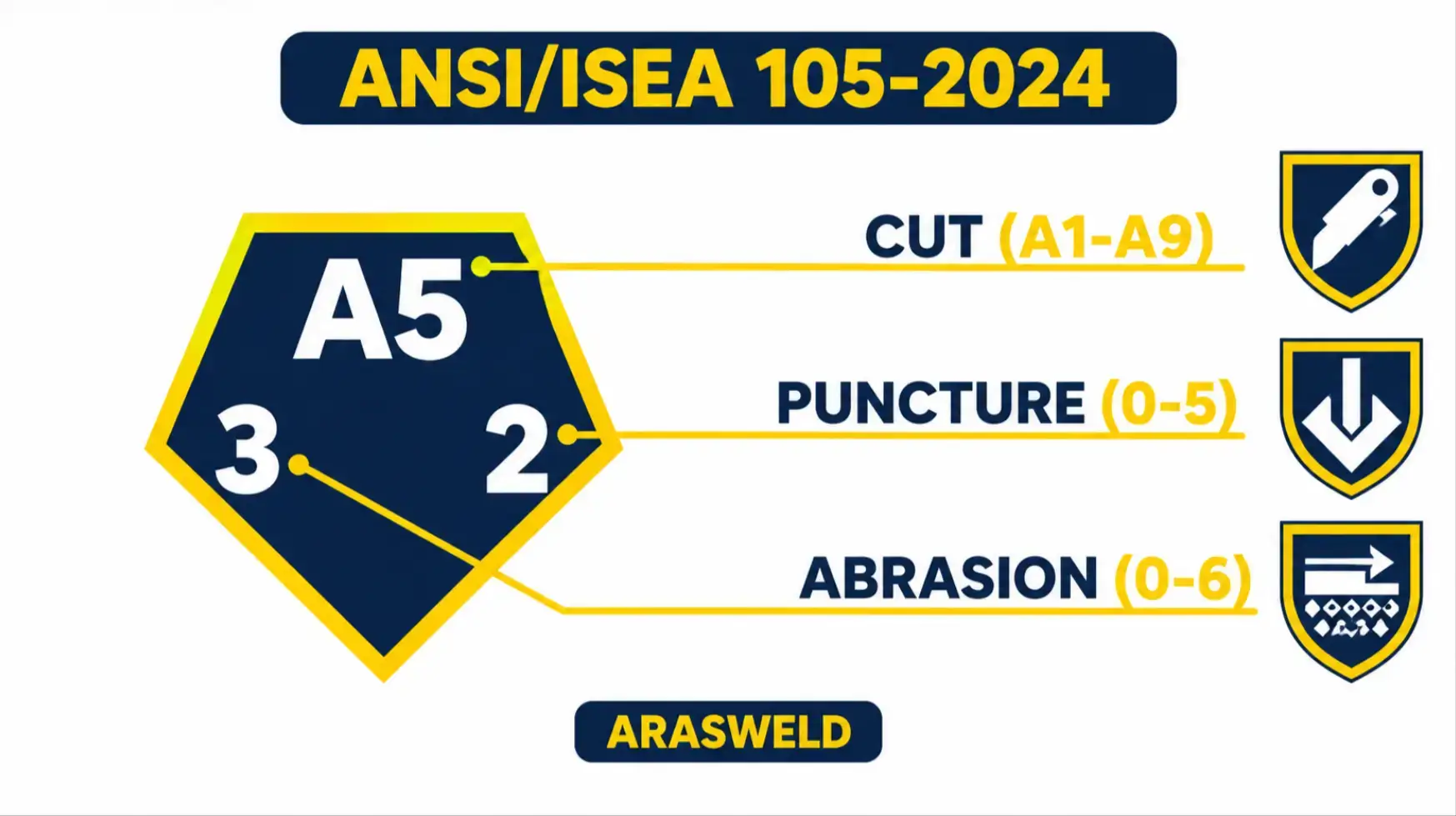
ANSI/ISEA 105-2024, released in November 2024, revises the 2016 edition of the American National Standard for Hand and Arm Protection Classification. Its most visible change is a standardized pentagon-shaped pictogram that consolidates abrasion, cut, and puncture resistance ratings into one consistent identification system. The revision also updates conformity documentation and clarifies selected testing provisions.
Why Was ANSI/ISEA 105 Revised in 2024?
The 2024 revision addresses inconsistent product labeling by establishing a uniform, brand-independent method of displaying protective glove performance. Previously, manufacturers used varying shield designs and graphical arrangements, making it harder for industrial buyers and workers to identify and compare protection levels across different brands. The updated framework introduces a recognizable labeling format to improve consistency in product identification and procurement evaluation.
Key Changes Introduced in ANSI/ISEA 105-2024
The 2024 edition introduces three important updates to product identification and performance documentation:
-
Standardized pentagon pictogram: Combines cut, abrasion, and puncture ratings within one uniform badge.
-
Conformity assessment documentation: Introduces specific provisions referencing ANSI/ISEA 125-2021 for demonstrating conformity with claimed performance classifications.
-
Updated testing provisions: Clarifies abrasion testing, updates conductive heat resistance classification requirements, and refreshes referenced ASTM and ISO test methods.
Changes to Hand and Arm Protection Classification
ANSI/ISEA 105-2024 explicitly expands the standard’s scope to include arm protection, particularly protective sleeves, alongside gloves. Manufacturers must provide documented evidence supporting claimed performance classifications using the conformity assessment approaches referenced in ANSI/ISEA 125-2021. The objective is greater traceability and substantiation of product performance, rather than reliance on unsupported marketing claims.
Updated Glove Markings and Performance Identification
The 2024 edition replaces decentralized shield-style graphics with a standardized five-sided pentagon badge. Its fixed arrangement identifies three mechanical protection categories:
-
Top center: Cut resistance, A1–A9.
-
Left: Abrasion resistance, 0–6.
-
Right: Puncture resistance, 0–5.
-
X: Indicates that a particular attribute was not tested or is not applicable, as appropriate.
This arrangement allows procurement teams to identify three key performance classifications without interpreting different manufacturer-specific shield designs.
-
| Comparison | ANSI/ISEA 105-2016 | ANSI/ISEA 105-2024 |
|---|---|---|
| Labeling | Varying shield designs | Standardized pentagon |
| Conformity documentation | Earlier reporting framework | Specific reference to ANSI/ISEA 125-2021 |
| Test methods | Previous referenced editions | Updated references and selected clarifications |
| Scope | Hand protection | Hand and arm protection |
What Should Manufacturers, Distributors, and Buyers Know About the 2024 Edition?
B2B procurement teams should prioritize updated product identification and traceable performance documentation when reviewing glove inventories. Buyers should audit existing specifications, identify products carrying legacy 2016 markings, and request updated ANSI/ISEA 105-2024 pentagon-labeled documentation from suppliers. Manufacturers and distributors should ensure that declared ratings are supported by appropriate test reports and conformity assessment evidence.
Technical accuracy note: The 2024 revision does not introduce an entirely new testing system or new protection-level scales. ISEA identifies product labeling as the principal change. Also, the cut rating belongs at the top center, not the top right, of the pentagon. Referencing ANSI/ISEA 125-2021 should not be interpreted as a universal third-party certification mandate.
Understanding ANSI/ISEA 105 Glove Ratings and Performance Levels
The ANSI/ISEA 105 rating framework provides a standardized method for evaluating and comparing protective glove performance against specific occupational hazards. Its classifications translate laboratory measurements into practical performance levels, helping HSE managers, safety engineers, and procurement teams select hand protection based on measurable material properties rather than marketing descriptions.
What Do ANSI Glove Ratings Mean?
ANSI glove ratings are standardized, objective performance benchmarks that quantify how protective glove materials withstand specific laboratory-tested hazards. Rather than relying on manufacturer descriptions such as heavy-duty, cut-resistant, or industrial-grade, these classifications provide measurable results that help HSE managers compare products and allocate appropriate PPE.
The ratings evaluate distinct performance characteristics, including cut resistance, abrasion resistance, and puncture resistance. Each classification represents a specific test result, not a universal measurement of overall glove safety.
Understanding ANSI Performance Levels and Classification
ANSI/ISEA 105 uses numerical performance classifications to distinguish different levels of protection within individual hazard categories. The scale typically begins at Level 0, representing baseline or unrated protection, and progresses toward higher performance thresholds.
Importantly, these levels are category-specific. A glove with excellent abrasion resistance does not automatically provide equivalent cut or puncture protection. Procurement teams must evaluate each classification independently against the workplace hazard assessment.
ANSI Cut Resistance Levels Explained
ANSI cut resistance levels A1–A9 classify glove materials according to the cutting force required to penetrate a specimen under the ASTM F2992-15 TDM test method. The measurement is expressed in grams, with the test requiring exactly 20 mm of blade travel to cleanly cut through the material specimen under controlled laboratory conditions.
| ANSI Cut Level | Cut Resistance (grams) | Typical Application |
|---|---|---|
| A1 | 200–499 | Light-duty handling |
| A2 | 500–999 | General assembly |
| A3 | 1,000–1,499 | Moderate material handling |
| A4 | 1,500–2,199 | Industrial welding, sharp sheet metal, glass cutting |
| A5 | 2,200–2,999 | Heavy material handling |
| A6 | 3,000–3,999 | Heavy fabrication |
| A7 | 4,000–4,999 | High cut-risk operations |
| A8 | 5,000–5,999 | Severe cutting hazards |
| A9 | ≥ 6,000 | Extreme cutting hazards |
This comprehensive ANSI cut rating chart identifies the strict gram-load thresholds required across nine levels under a mandatory 20 mm blade travel protocol.
For practical hazard assessment, these levels can be grouped into three general risk phases:
Low-to-Moderate Hazards (A1–A3): Light assembly, routine handling, and lower cut-risk material handling.
Moderate-to-Heavy Risks (A4–A6): Metal stamping, glass handling, and heavy fabrication.
Severe-to-Extreme Hazards (A7–A9): Demanding cutting environments and high-risk extraction operations.
ANSI Abrasion Resistance Ratings
ANSI abrasion ratings measure how many abrasion cycles a glove material withstands before developing a hole under specified test conditions. The classification ranges from Level 0 to Level 6, with higher levels indicating greater measured abrasion resistance.
| ANSI Level | Minimum Abrasion Result | Test Load |
|---|---|---|
| 0 | < 100 cycles | — |
| 1 | ≥ 100 cycles | 500 grams |
| 2 | ≥ 500 cycles | 500 grams |
| 3 | ≥ 1,000 cycles | 500 grams |
| 4 | ≥ 3,000 cycles | 1,000 grams |
| 5 | ≥ 10,000 cycles | 1,000 grams |
| 6 | ≥ 20,000 cycles | 1,000 grams |
The ANSI abrasion rating matrix delineates the exact wear cycles to failure, highlighting the heavier 1,000-gram load required to certify high-durability levels 4 through 6.
A critical testing distinction applies to Levels 4–6: specimens are evaluated under a heavier 1,000-gram load, using previously untested material when the material exceeds 1,000 cycles under the 500-gram test. This distinction matters when comparing glove durability claims across different product constructions.
ANSI Puncture Resistance Ratings
ANSI puncture resistance classifications evaluate a material’s ability to resist penetration by a pointed object under perpendicular force. The assessment focuses on non-hypodermic puncture hazards, helping buyers evaluate protective materials against mechanical penetration. These ratings should not be interpreted as protection against needles or hypodermic objects.
Understanding ANSI/ISEA 105 Rating Charts
ANSI/ISEA 105 rating charts allow procurement teams to compare multiple mechanical protection classifications within one product specification. Buyers should examine cut, abrasion, and puncture results independently, then cross-reference them against the actual hazards, exposure conditions, and required handling performance of each industrial task.
Does a Higher ANSI Rating Always Mean a Better Glove?
A higher ANSI performance level does not automatically mean a better glove for every industrial application. Protection must be balanced against dexterity, fit, comfort, and task-specific functionality.
As a metallurgy and welding expert, I have learned that material performance must never be judged solely by a commercial name like cowhide leather, goatskin, or an aramid liner. Composition, microstructure, and construction dictate final performance. A higher ANSI level doesn’t mean a better glove if it compromises dexterity or fit. Final glove capability must be proven through standardized laboratory data.
ANSI/ISEA 105 Testing Methods: How Are Protective Gloves Evaluated?
ANSI/ISEA 105 classifications are established through controlled, repeatable laboratory testing rather than commercial marketing claims. Each test measures a defined material response under specified conditions. The resulting performance data enables manufacturers, HSE managers, and industrial procurement teams to compare protective equipment against measurable workplace hazards.
How ANSI/ISEA 105 Performance Testing Works
ANSI/ISEA 105-2024 establishes individual testing procedures and performance classifications for mechanical, chemical, and heat-related protection. Each property has its own test method, measurement criteria, and rating system.
| Performance Property | Test Method | Rating System | What the Result Indicates |
|---|---|---|---|
| Cut resistance | ASTM F2992-15 | A1–A9 | Resistance to a specified blade-cut test |
| Abrasion resistance | ASTM D3389 or ASTM D3884, as applicable | 0–6 | Resistance to abrasion under specified test conditions |
| Non-hypodermic puncture resistance | EN 388:2016 puncture method | 0–5 | Force required to puncture the specimen using the specified probe |
This master performance overview matrix maps out the primary ASTM and EN testing standards that govern compliance under the standardized hand protection framework.
Cut Resistance Testing: ASTM F2992 and TDM Testing
ASTM F2992-15 uses a Tomodynamometer (TDM) testing machine to measure the force required for a sharp blade to cut through a material specimen. The machine applies a controlled load and records the cutting force required at 20 mm of blade travel. Results are expressed in grams and classified from A1 to A9. The classification is based on an average of at least three specimens.
Europe’s EN 388:2016, incorporating EN ISO 13997, uses a comparable straight-blade TDM approach but reports results in Newtons (N) across levels A–F. Its separate circular-blade Coupe test uses an index scale from 1–5. ASTM F1790 is an earlier predecessor in standardized protective-material cut testing. These scales should not be treated as directly interchangeable.
Abrasion Resistance Testing
ANSI/ISEA 105 evaluates abrasion resistance through ASTM D3389 or ASTM D3884, using a rotary-platform abrasion apparatus and H-18 abrasive wheels. The test subjects specimens to repeated surface friction until the specified material-failure endpoint is reached.
Levels 0–3 use a 500-gram load, while Levels 4–6 use a 1,000-gram load on new, previously untested specimens when the material exceeds 1,000 revolutions under the lighter load. ASTM D3389 applies to coated materials, while ASTM D3884 addresses uncoated materials in this classification procedure.
The Martindale method (ISO 12947) is a separate abrasion-testing approach that uses a standard fabric abradant and a multidirectional Lissajous movement pattern. It should not be confused with the ASTM rotary-platform procedures specified for ANSI abrasion classifications.
Puncture Resistance Testing
Non-hypodermic puncture testing measures the perpendicular force required for a specified probe to penetrate a protective material specimen. A tensile testing machine drives the probe through the material and records the penetration force in Newtons (N).
| ANSI Level | Puncture Force (Newtons) | Interpretation |
|---|---|---|
| 0 | Below 10 N | Light hazards |
| 1 | At least 10 N | Light hazards |
| 2 | At least 20 N | Light hazards |
| 3 | At least 60 N | Moderate hazards |
| 4 | At least 100 N | Moderate hazards |
| 5 | At least 150 N | High hazards |
The non-hypodermic puncture matrix outlines the Newton force progression across six levels, establishing that this methodology explicitly does not evaluate or predict resistance against medical needle-stick injuries.
At least 12 specimens are averaged to determine the non-hypodermic classification. This method evaluates industrial penetration hazards such as sharp machinery components, moving pipes, and drilling materials.
An important distinction applies to the 2024 edition: ANSI/ISEA 105 also recognizes hypodermic needle puncture resistance as a separate performance category. ASTM F2878 specifies needle probes of 21, 25, or 28 gauge. Therefore, the non-hypodermic results above cannot substitute for separate needle-puncture test results.
Chemical Permeation and Degradation Testing
Chemical permeation testing measures the time required for a chemical to pass through protective glove material, while degradation testing evaluates physical deterioration following chemical exposure. Permeation methods such as ASTM F739 measure chemical breakthrough under continuous contact. Buyers should evaluate results against the specific chemical, concentration, exposure duration, and intended working conditions rather than assume universal chemical resistance.
Thermal-Related Performance Testing
ANSI/ISEA 105-2024 classifies specific heat and flame properties through ignition resistance, after-flame behavior, heat degradation, and conductive heat resistance. The 2024 revision also clarifies conductive heat classification by specifying temperature ranges and additional assessment criteria.
The 5-joule impact test is a separate mechanical-impact assessment under EN 388:2016, not an ANSI thermal test. It uses a 2.5-kilogram striker; the transmitted force must average no more than 7 kN, with individual results not exceeding 9 kN. A passing result receives P; this impact classification must not be confused with heat resistance or ANSI/ISEA 105 thermal ratings.
Understanding Test Results, Performance Levels, and Limitations
Protective equipment selection must balance laboratory-confirmed physical protection with material comfort, ergonomic suitability, and long-term usability. The following supplementary methods can help characterize material properties:
Air permeability and breathability: ASTM D737:2004.
Thermal transmission: ASTM D5470:2017.
Water resistance: ISO 811:2018.
Material flexibility and stiffness: ASTM D1388:2018.
These are supplementary material-characterization methods, not additional ANSI/ISEA 105 protection ratings.
An expert ergonomics panel evaluation can complement laboratory results through structured wear trials. Multiple human subjects of different statures assess freedom of movement, glove overlap, and compatibility with industrial tools. Consumer evaluation-type matrices can organize these observations, helping procurement teams determine whether a glove’s measured protection is compatible with actual workplace requirements. This is a supplementary evaluation approach, not a prescribed ANSI/ISEA 105 certification test.
How to Read ANSI/ISEA 105 Glove Labels and Markings
Accurate interpretation of physical glove markings is the first line of defense in industrial PPE compliance. HSE managers and procurement teams must connect each classification to the exact product, its test evidence, and the hazards identified in the workplace.
What Information Should an ANSI-Rated Glove Label Include?
A procurement-ready label or accompanying product documentation should identify the manufacturer, exact model or product code, glove size, and applicable performance markings. These details let buyers match the rated item to the product ordered, received, and issued.
Understanding the ANSI/ISEA 105 Pictogram
ANSI/ISEA 105-2024 introduces a standardized, brand-agnostic five-sided pentagon that consolidates cut, abrasion, and puncture classifications into one marking, replacing manufacturers’ varied legacy shields and graphics.
How to Interpret Cut, Abrasion, and Puncture Ratings
Read each position independently: cut resistance appears at the top center (A1–A9), abrasion on the left (0–6), and non-hypodermic puncture on the right (0–5). An “X” means the classification was not tested or is not applicable; it is not a rating of zero.
How to Verify Glove Performance Documentation
My experience in metallurgy, manufacturing, and quality control has taught me that technical claims require traceable evidence. I do not accept catalogue ratings at face value. B2B buyers should request the official laboratory test report and verify five points:
-
Confirm that the report identifies the exact glove model being purchased.
-
Verify that testing cites ANSI/ISEA 105-2024, not an obsolete revision.
-
Check for separate results for cut, abrasion, and puncture.
-
Ensure the laboratory classifications substantiate the manufacturer’s catalogue claims.
-
Confirm that the supplied glove’s physical construction matches the tested specimen.
Common Mistakes When Reading ANSI Glove Labels
A high score in one category does not establish protection against unrelated hazards. A strong cut rating does not prove resistance to thermal degradation, chemical exposure, or hypodermic needle penetration. Also, ANSI does not approve or certify individual gloves; use the full designation ANSI/ISEA 105-2024 and review conformity evidence. Match every relevant classification to the workplace hazard assessment before approval.
ANSI/ISEA 105 vs. EN 388: Understanding the Differences
Both ANSI/ISEA 105-2024 and EN 388:2016 assess mechanical hand hazards, but their procedures, equipment, force units, and rating scales differ. Procurement teams must interpret each result within its own framework rather than treating corresponding numbers as equivalent.
What Is EN 388 and What Does It Measure?
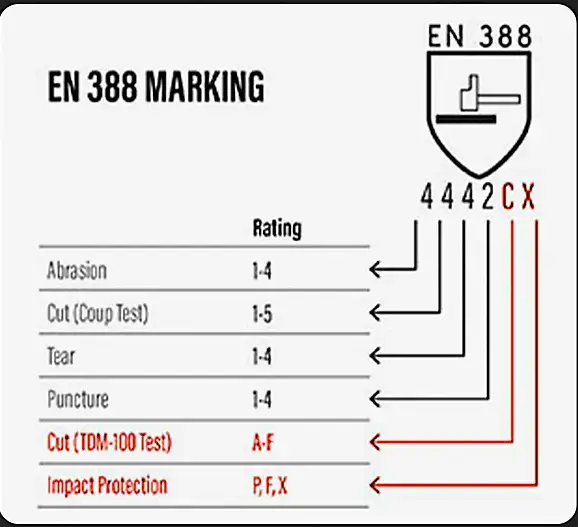
EN 388:2016 specifies four primary mechanical-protection properties: abrasion, blade cut, tear, and puncture, with impact protection assessed where applicable. ANSI/ISEA 105-2024 classifies cut, abrasion, and puncture resistance but has no independent tear rating. EN 388 tear testing pulls a prepared specimen apart in a tensile tester; the required force is reported in Newtons across Levels 1–4.
ANSI/ISEA 105 vs. EN 388: Cut Resistance Testing
ASTM F2992-15 uses a straight-blade Tomodynamometer (TDM), reporting ANSI cut resistance in gram-force values across A1–A9. EN 388 uses both a circular-blade Coupe test (index Levels 1–5) and a straight-blade EN ISO 13997 TDM test (Levels A–F in Newtons). ASTM F1790 is an earlier foundational method. EN 388 itself specifies that its two cut-test scales are not correlated.
ANSI vs. EN 388: Abrasion Resistance Classification
ANSI abrasion classification uses ASTM D3389 or ASTM D3884 rotary-platform methods, with Levels 0–6. EN 388 uses ISO 12947 Martindale abrasion, where an abrasive surface rubs the specimen until breakthrough; its scale runs from Levels 1–4. Different apparatus, abrasives, loads, and endpoints prevent direct conversion.
ANSI vs. EN 388: Puncture Resistance Classification
Both systems assess non-hypodermic puncture by measuring the force required for a probe to penetrate the specimen, but their classification scales differ. ANSI/ISEA 105 uses Levels 0–5, while EN 388 uses Levels 1–4. Results are expressed in Newtons. The methods should not be assumed to use identical probe specifications or test apparatus; EN 388 specifies a compression-testing procedure. Neither rating establishes medical needle-stick protection.
ANSI and EN 388 Rating Comparison Table
The following table compares the principal mechanical test methods and their respective classification systems.
| Protection Parameter | ANSI/ISEA 105-2024 (US) | EN 388:2016 (Europe) |
|---|---|---|
| Cut Resistance (Straight Blade) | ASTM F2992-15 (TDM); A1–A9 (gram-force) | EN ISO 13997 (TDM); A–F (Newtons) |
| Cut Resistance (Circular Blade) | Not used | Coupe test; index Levels 1–5 |
| Abrasion Resistance | ASTM D3389 / D3884 (rotary platform); Levels 0–6 | ISO 12947 (Martindale); Levels 1–4 |
| Tear Resistance | Not independently rated | Tensile tear test; Levels 1–4 (Newtons) |
| Non-Hypodermic Puncture | Probe test; Levels 0–5 (Newtons) | Rounded stylus test; Levels 1–4 (Newtons) |
| Impact Protection | Separate standard: ANSI/ISEA 138; Classes 1–3 | EN 388 impact assessment using EN 13594:2015 criteria; 5 J; P marking when passed |
This comparative matrix contrasts the American and European mechanical protection standards, demonstrating why direct numerical equivalence between ANSI/ISEA 105 and EN 388 ratings is technically invalid.
Force units: ANSI cut results use gram-force values; EN ISO 13997 reports Newtons.
Blade mechanics: ANSI uses straight-blade TDM; EN 388 includes straight-blade TDM and circular-blade Coupe testing.
Tear testing: EN 388 rates tear resistance; ANSI/ISEA 105 does not.
Impact grading: ANSI uses separate ANSI/ISEA 138 Classes 1–3; EN 388 uses a pass marking for qualifying 5-joule impact protection.
EN 388 impact testing uses a 2.5 kg striker and 5 J energy on a domed anvil. The requirement is a mean transmitted force no greater than 7 kN, with no individual result above 9 kN; a passing glove receives “P.” ANSI/ISEA 138 separately classifies dorsal protection: Classes 1, 2, and 3 have progressively lower mean transmitted-force limits of 9, 6.5, and 4 kN. The absence of “P” on an EN 388 marking does not by itself distinguish failure from an unclaimed or untested result.
Can ANSI and EN 388 Ratings Be Directly Compared?
No. ANSI/ISEA 105 and EN 388 ratings cannot be mathematically converted. Blade geometry, abrasion equipment, tear coverage, test loads, and thresholds differ; buyers should compare complete laboratory reports against destination-market requirements and workplace risk assessments.
ANSI/ISEA 105 classifies specified mechanical and heat-related properties, while EN 388 addresses mechanical risks and EN 407 evaluates defined thermal hazards; these European standards complement rather than replace ANSI classifications. For a detailed comparison of the European mechanical and thermal frameworks in welding-glove selection, read our EN 388 vs. EN 407: What Is the Difference for Welding Gloves?.
ANSI/ISEA 105 vs. Other Protective Glove Standards
Industrial hand protection often requires cross-referencing ANSI/ISEA 105 with specialized thermal, welding, and general glove-design standards. Understanding each framework’s scope helps procurement teams avoid treating one performance classification as proof of complete protection.
| Standard or Framework | What It Addresses | How It Relates to ANSI/ISEA 105 |
|---|---|---|
| ANSI/ISEA 105-2024 | Classification of specified hand and arm protection performance properties | The article's main subject |
| EN 388:2016 | Mechanical risks, including abrasion, cut, tear and puncture | The key comparison for mechanical performance |
| EN 407 | Specified thermal risks | Complementary when assessing welding-related heat and flame hazards |
| EN 12477 | Protective gloves for welders; includes specified mechanical and thermal performance requirements | The most directly relevant welding-glove standard in this comparison |
| EN ISO 21420 | General requirements for protective gloves, such as design, innocuousness and sizing | A general glove-requirements reference, not a substitute for performance classifications |
| OSHA 29 CFR 1910.138 | US employer requirements for hand protection | A US workplace requirement, not a glove-testing or certification standard |
This macro-regulatory matrix clarifies the distinct functional boundaries between mechanical, thermal, welding-specific, and workplace compliance frameworks.
ANSI/ISEA 105 vs. EN 407: Thermal Protection
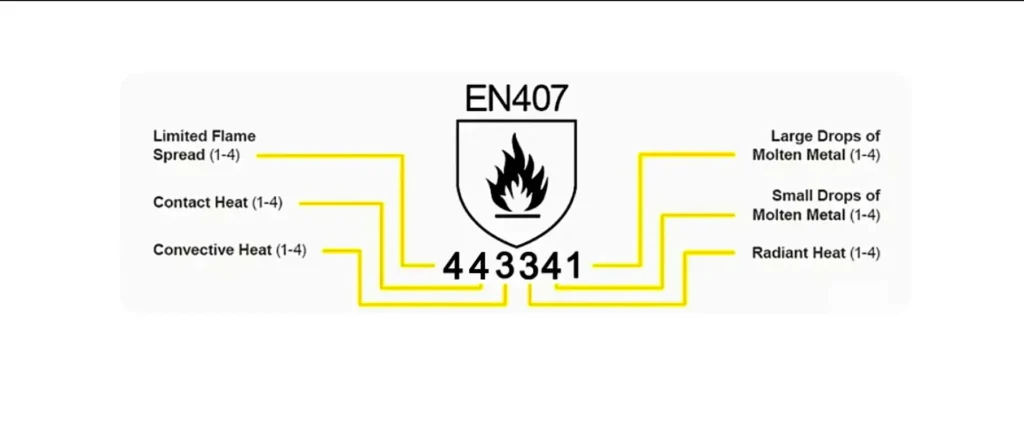
ANSI/ISEA 105 includes ignition, burning-behavior, and conductive-heat classifications, whereas EN 407:2020 evaluates six thermal hazards: limited flame spread, contact heat, convective heat, radiant heat, small molten-metal splashes, and large quantities of molten metal. For welding-related exposure, review the relevant EN 407 standard for thermal risks results rather than relying on a general mechanical rating.
ANSI/ISEA 105 vs. EN 12477: Welding Protective Gloves
EN 12477 is specifically intended for protective gloves used in manual metal welding, cutting, and allied processes. It combines specified EN 388 mechanical and EN 407 thermal requirements into Type A (lower dexterity, higher protective performance) and Type B (higher dexterity, lower performance in certain protection categories) classifications. See the EN 12477 welding gloves standard for welding-specific selection criteria.
ANSI/ISEA 105 vs. EN ISO 21420: General Glove Requirements
EN ISO 21420 establishes general requirements for glove design, innocuousness, sizing, comfort, and dexterity. It addresses material considerations such as pH and chromium VI; it is a foundational requirements standard, not an independent hazard-rating system. Consult EN ISO 21420 protective gloves alongside the relevant protection standard.
ANSI/ISEA 105 vs. ASTM F1342: Puncture Resistance Testing
ASTM F1342/F1342M measures the force needed for a pointed probe to penetrate protective-clothing material. It is a separate laboratory test method; buyers should not automatically treat an F1342 result as an ANSI/ISEA 105 puncture classification. Verify the exact method cited in the laboratory report.
Which Standard Should Industrial Buyers Consider?
US buyers should assess glove performance against OSHA 29 CFR 1910.138 and use ANSI/ISEA 105-2024 classifications where relevant to the identified hazards. OSHA requires hazard-based selection; it does not mandate ANSI/ISEA 105 certification. For welding and thermal applications, request relevant EN 407 and EN 12477 evidence as complementary technical documentation.
How to Choose Protective Gloves Using ANSI/ISEA 105 Ratings
Translating laboratory ratings into effective PPE procurement requires matching hazard severity with glove construction, ergonomics, and material properties. Selected gloves must provide verified protection without unnecessarily reducing dexterity or task control.
Identify Workplace Hazards Before Selecting Gloves
Assess each task for eight dimensions: abrasion, cut, tear, puncture, impact, thermal exposure, flexibility, and ergonomics. Evaluate contact surfaces, exposure duration, temperature, and tool use. OSHA requires selection based on the tasks, working conditions, duration, and identified hazards; no single glove protects against every hazard.
How to Select Gloves Based on Cut Resistance
ANSI A1–A3 are commonly considered for lower-cut-risk assembly and general handling; A4–A6 for sheet metal and fabrication; and A7–A9 for severe sharp-edge hazards. These are starting points, not universal approvals. Confirm that the glove permits safe gripping and tool control.
How to Select Gloves Based on Abrasion and Puncture Resistance
Repeated high-friction handling may require higher abrasion classifications, particularly Levels 4–6. Burrs, wire ends, and splinters may require non-hypodermic puncture Levels 3–5. These ratings address different failure modes; one cannot substitute for the other.
Balancing Protection, Dexterity, Comfort, and Durability
Overly thick or stiff gloves can reduce fingertip control and increase fatigue. Supplementary assessments include air permeability (ASTM D737:2004), thermal transmission (ASTM D5470:2017), water resistance (ISO 811:2018), and flexibility or stiffness (ASTM D1388:2018); these are not ANSI/ISEA 105 protection ratings. Wear trials across workers of different statures should assess fit, grip, movement, and tool compatibility. See how long do welding gloves last and clean leather welding gloves safely for service-life and maintenance guidance.
Understanding Glove Materials and Construction
Material names suggest design advantages, not guaranteed ratings; evaluate the complete glove:
- Cowhide: Common in heavy-duty gloves for durability, abrasion resistance, and thermal insulation, performance depends on grade, thickness, tanning, and construction.
- Goatskin: Fine grain and flexibility support tactile handling and a favorable strength-to-weight profile. See cowhide vs goatskin welding gloves.
- Deerskin: Soft and supple, often selected for extended-wear comfort and hand movement.
- Split vs. grain leather: Split leather has a rougher surface and can provide grip and insulation; top-grain leather is smoother and may resist surface moisture depending on its finish. See split leather vs grain leather gloves.
- Aramid/Kevlar: High-strength fibers can contribute cut resistance and thermal stability; aramid sewing thread can reinforce seams. See welding glove materials tech.
- Cotton/fleece linings: Can absorb perspiration and improve insulation and comfort, depending on thickness and construction.
- Reinforcement, mesh, and layers: Palm patches, reinforced seams, and layered panels protect high-wear areas. Single-layer, low-profile designs resemble unobtrusive protection; multi-layer builds provide more substantial, overt reinforcement but may restrict dexterity. Stainless-steel mesh can provide very high cut/slash protection in specialized cutting operations, but its weight, flexibility, and heat conductivity must suit the task. Verify complete-glove test data and compatibility.
A Practical ANSI Glove Selection Checklist for Procurement Teams
Use this six-step process before approving a glove:
Assess hazards: Document the risks associated with each task.
Specify ratings: Set required performance levels for relevant protection properties.
Verify test evidence: Check the exact model, test methods, standard edition, and laboratory results.
Review construction: Examine leather, lining, seams, reinforcements, cuffs, and overall design.
Trial samples: Evaluate sizing, grip, dexterity, movement, and tool compatibility with representative workers.
Document approval: Record worker feedback, inspection criteria, replacement intervals, and supplier traceability.
ANSI/ISEA 105 and Welding Gloves: What Do Manufacturers and Buyers Need to Know?
ANSI/ISEA 105 is not a dedicated welding standard, but its mechanical classifications help buyers assess cut, abrasion, and puncture risks in welding gloves. These results must be evaluated alongside thermal performance and welding-specific requirements before a glove is approved for a process or task.
Does ANSI/ISEA 105 Certify Welding Gloves?
No. ANSI/ISEA 105-2024 is a general hand-protection classification standard, not a dedicated welding-glove certification. Manufacturers can use its relevant test methods to document mechanical performance, but those ratings do not independently establish suitability for welding heat, molten spatter, or arc-related exposure. Compare glove constructions in types of welding gloves comparison and request separate thermal evidence.
ANSI/ISEA 105 and MIG Welding Gloves
MIG (GMAW) gloves must balance heat and spatter exposure with abrasion resistance and control of the welding-gun trigger. Material handling and joint preparation can introduce additional cut hazards. A3–A5 cut ratings and abrasion Levels 4–6 may be useful procurement starting points for some operations, but they are not MIG requirements or universal recommendations. Assess actual edges, contact frequency, welding current, position, and duty cycle. Consult the high-heat mig welding gloves guide and High-Heat MIG & MAG Gloves 932°F product specification; verify any stated temperature claim and its test basis rather than treating it as an ANSI rating.
ANSI/ISEA 105 and TIG Welding Gloves
TIG (GTAW) glove selection prioritizes fingertip sensitivity for filler-rod feeding and precise torch control while retaining adequate heat protection. Thin, well-fitted grain leather can support dexterity, but reduced thickness may also reduce thermal and mechanical protection. A2–A4 cut ratings can be considered for tasks with modest cut exposure, not as a universal TIG specification. Review the precision tig welding gloves guide and Professional TIG Welding Gloves specifications.
ANSI/ISEA 105 and Stick (SMAW) Welding Gloves
Stick welding gloves must address radiant heat, hot slag, and molten spatter while tolerating electrode handling and post-weld chipping. Heavy-duty split leather, secure seams, and suitable cuffs may be appropriate, but construction alone does not prove a protection level. Verify the finished glove’s test reports and review the heavy-duty stick welding gloves guide and Impact Abrasion Resistant Gloves specifications.
Procurement Note: The ANSI cut and abrasion levels listed above serve strictly as baseline selection benchmarks, not mandatory process specifications. Final glove approval must always rely on task-specific hazard audits and verified laboratory test reports.
Understanding Cut Resistance in Welding Glove Materials
Cut resistance in welding gloves depends on the complete material system, not leather thickness alone. Cowhide or goatskin outer layers combined with aramid or Kevlar liners can contribute to improved cut performance. From my perspective as a metallurgist with a master’s degree, I also consider seam design, panel placement, material composition, and the exact tested construction; a fiber or leather name alone cannot substantiate a finished-glove rating.
Why ANSI/ISEA 105 Ratings Alone Are Not Enough for Welding Protection
My 12+ years of hands-on welding experience across industrial processes proves that a welder’s hand hazards are never limited to the moment the arc is struck. Because ANSI/ISEA 105 does not assign process-specific ratings for MIG, TIG, or Stick welding, procurement must evaluate the entire workflow.
- Pre-weld preparation and fit-up: Handling sharp sheet-metal edges, sheared plates, and burrs creates immediate mechanical cut and puncture risks.
- Active welding arc operations: TIG demands fine finger dexterity, whereas Stick and high-amperage MIG expose gloves to radiant heat, slag, and molten spatter.
Post-weld handling, grinding, and finishing: Chipping slag and grinding welds reintroduce surface abrasion and sharp-edge mechanical hazards.
How to Evaluate Welding Gloves Using Multiple Performance Standards
A complete welding-glove evaluation should assess eight dimensions: abrasion, cut, tear, puncture, impact, thermal protection, flexibility, and ergonomics. Cross-reference ANSI/ISEA 105-2024 classifications and applicable heat data with EN 407 thermal results, EN 12477 welding-glove classifications, and ANSI/ISEA 138 impact documentation where relevant. Match the evidence to the actual welding process, workpiece, operating conditions, and workplace exposure assessment.
A complete welding-glove evaluation should assess eight dimensions: abrasion, cut, tear, puncture, impact, thermal protection, flexibility, and ergonomics. For a broader explanation of glove types, materials, sizes, EN 388, EN 407, EN 12477, care, and purchasing considerations, see our complete guide to welding gloves.
OSHA Requirements and ANSI/ISEA 105: What Employers Need to Know
Federal OSHA regulations establish employers’ duties to provide appropriate hand protection, while ANSI/ISEA 105-2024 supplies standardized performance classifications that inform glove selection. The frameworks serve different roles: OSHA establishes enforceable workplace obligations; ANSI/ISEA 105 provides test-based performance information.
What Does OSHA 29 CFR 1910.138 Require?
Under 29 CFR 1910.138(a), employers must select and require appropriate hand protection when work exposes employees to recognized hand hazards. These include harmful-substance absorption, severe cuts, abrasions, punctures, chemical burns, thermal burns, and harmful temperature extremes.
The applicable federal requirements are set out in OSHA’s 29 CFR 1910.138 Hand Protection regulation, which establishes employers’ responsibilities for selecting appropriate hand protection.
How ANSI/ISEA 105 Supports Hand Protection Selection
ANSI/ISEA 105-2024 provides laboratory-based classifications for specified performance properties, including cut, abrasion, and puncture resistance. Safety managers can use these results to compare glove options against identified hazards; the standard does not replace OSHA’s task-specific selection requirements.
Compliance Note: While ANSI/ISEA 105-2024 provides the standardized performance classification framework, OSHA 29 CFR 1910.138 does not prescribe a specific mandatory ANSI rating level. Employers must select protection levels based on their documented workplace hazard assessment.
Hazard Assessment and Selection of Appropriate Hand Protection
Under 1910.138(b), glove selection must consider performance characteristics relative to the tasks, workplace conditions, duration of use, and identified or potential hazards. OSHA 1910.132(d) also requires a workplace PPE hazard assessment and written certification documenting that assessment.
Employer Responsibilities for Protective Gloves
Employers must implement the following obligations:
- Assess hazards: Identify workplace risks, document the assessment, and select PPE that addresses them.
- Provide PPE: Supply required protective gloves at no cost, subject to the exceptions in 1910.132(h); replacement PPE is also provided at no cost unless lost or intentionally damaged.
- Ensure proper fit: Select gloves that properly fit each affected employee.
Train workers: Explain when PPE is necessary, correct use, limitations, care, maintenance, useful life, and disposal; verify employee understanding.
ANSI/ISEA 105 Compliance vs. OSHA Compliance
Purchasing ANSI-rated gloves does not automatically establish OSHA compliance. Employers remain responsible for hazard assessment, appropriate selection, proper fit, employee training, and ensuring defective or damaged PPE is not used. Safety teams planning large-scale compliant rollouts should coordinate specifications, traceability, sizing, and replacement planning through B2B bulk and wholesale procurement.
Common Misconceptions About ANSI/ISEA 105
Misinterpreting glove ratings can create serious compliance gaps and expose workers to preventable hand injuries. Understanding what each classification measures—and what it does not measure is essential for defensible PPE selection.
Does ANSI/ISEA 105 Certify Every Protective Glove?
No. ANSI/ISEA 105 is a voluntary consensus classification standard, not a system that automatically certifies every glove on the market. Manufacturers must substantiate claimed ratings through testing of the specific glove model using applicable methods.
Does a Higher Cut Rating Mean Better Thermal Protection?
No. A1–A9 measures mechanical blade-cut resistance, not contact heat, radiant heat, or molten-metal protection. Some cut-resistant synthetic fibers can soften or melt under welding heat unless the complete glove construction provides suitable thermal protection.
Are ANSI and EN 388 Ratings Interchangeable?
No. ANSI/ISEA 105 and EN 388 use different test equipment, blade geometries, force units, and classification thresholds. Their results cannot be reliably converted or treated as numerically equivalent.
Does an ANSI Rating Guarantee Workplace Safety?
No. Laboratory classifications measure performance under controlled test conditions, not every variable encountered during actual use. Wear, contamination, improper fit, physical damage, and exposure duration can affect protection and require ongoing inspection.
Can One Pair of Gloves Protect Against Every Workplace Hazard?
No. A glove optimized for heavy thermal insulation may not provide extreme cut resistance, chemical protection, and fine tactile dexterity simultaneously. Employers must match verified glove performance to individual tasks and identified workplace hazards.
B2B Procurement: Work With ARASWELD
Safety managers and bulk buyers can consult ARASWELD about industrial welding and hand-protection solutions supported by product specifications and available test documentation. Contact the contact ARASWELD’s technical procurement team to discuss application requirements, product selection, and bulk purchasing needs.
Frequently Asked Questions About ANSI/ISEA 105
These concise answers address key compliance, testing, and selection questions regarding ANSI/ISEA 105-2024.
What Is ANSI/ISEA 105?
ANSI/ISEA 105-2024 is a U.S. voluntary consensus standard establishing test methods and performance classifications for specified hand and arm protection properties, including mechanical, chemical, and heat-related performance.
What Does ANSI 105 Mean on Work Gloves?
A correctly substantiated ANSI/ISEA 105 marking identifies specific tested performance classifications, such as cut, abrasion, and non-hypodermic puncture; it does not indicate universal protection against every workplace hazard.
What Are the ANSI Cut Resistance Levels?
There are nine classification levels, A1 through A9, ranging from A1 (200–499 grams) to A9 (at least 6,000 grams) under ASTM F2992-15, using 20 mm of straight-blade travel.
What Is the Highest ANSI Cut Rating?
A9 is the highest ANSI cut-resistance level, requiring at least 6,000 grams of applied load to achieve 20 mm of blade travel during the ASTM F2992-15 TDM test.
How Is ANSI Cut Resistance Tested?
ASTM F2992-15 uses a Tomodynamometer (TDM) with a straight blade, measuring the gram-force required to cut a specimen over 20 mm of blade travel under controlled conditions.
What Is the Difference Between ANSI/ISEA 105-2016 and 2024?
The 2024 revision introduces a standardized pentagon for cut, abrasion, and puncture markings, extends the scope to sleeves, and references ANSI/ISEA 125-2021 for conformity documentation.
Is ANSI/ISEA 105 Equivalent to EN 388?
No. ANSI/ISEA 105 and EN 388 use different test procedures, blade geometries, force units, and classification thresholds, so their performance levels cannot be directly converted or considered equivalent.
Are ANSI-Rated Gloves Required by OSHA?
No. OSHA 29 CFR 1910.138 requires employers to select hand protection based on workplace hazards, tasks, conditions, and exposure duration; it does not mandate ANSI/ISEA 105-rated gloves.
Does ANSI/ISEA 105 Cover Welding Gloves?
No. ANSI/ISEA 105 is not a welding-specific standard; its classifications evaluate selected glove properties, while welding suitability requires additional thermal evidence and relevant welding-glove requirements such as EN 12477.
How Can I Verify an ANSI Glove Rating?
Request the official laboratory report and verify the exact glove model, ANSI/ISEA 105-2024 reference, separate property results, laboratory identity, and supporting conformity documentation before accepting supplier claims.
What Is the Difference Between Cut, Abrasion, and Puncture Resistance?
Cut resistance measures straight-blade cutting force; abrasion measures surface-wear cycles under specified friction conditions; puncture measures the force needed for a probe to penetrate material perpendicularly, typically in Newtons.