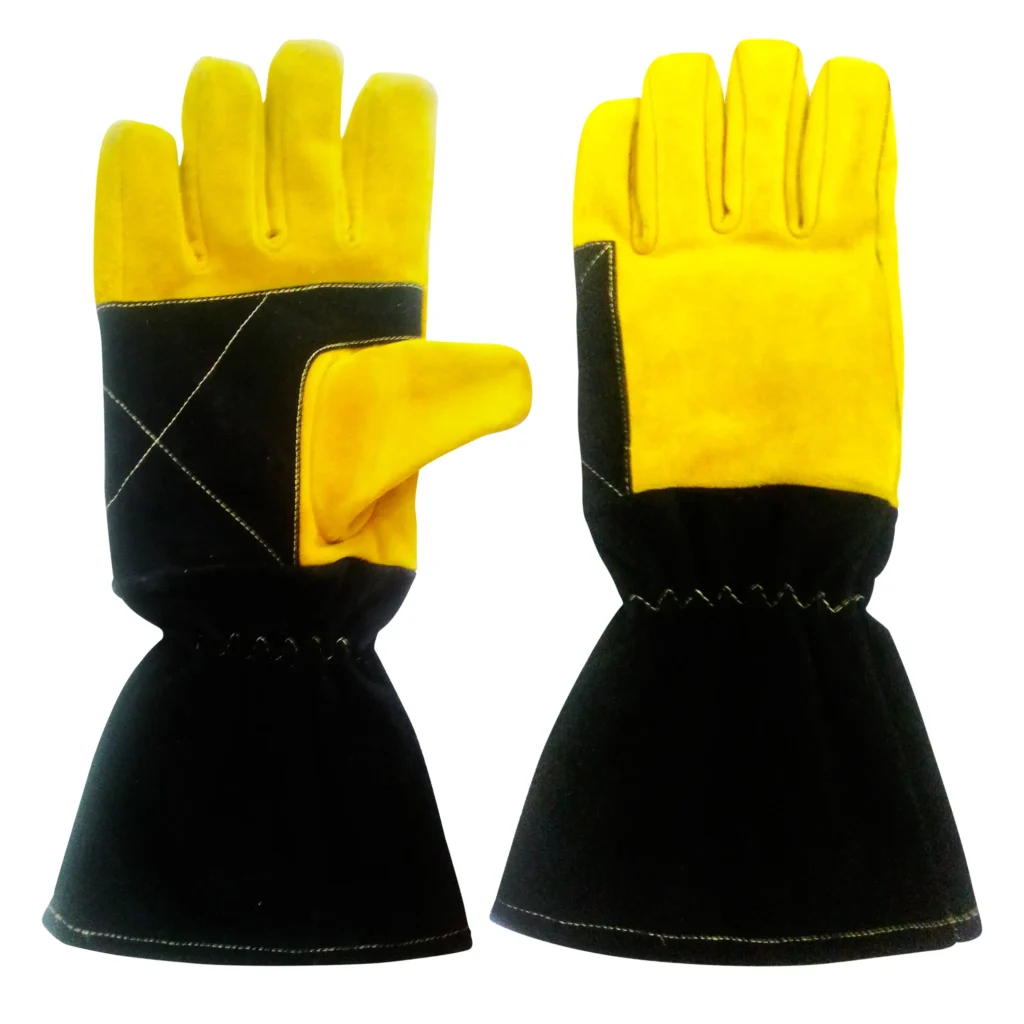
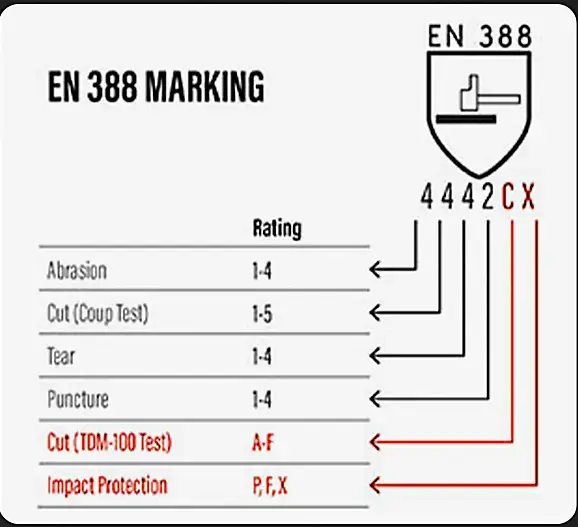
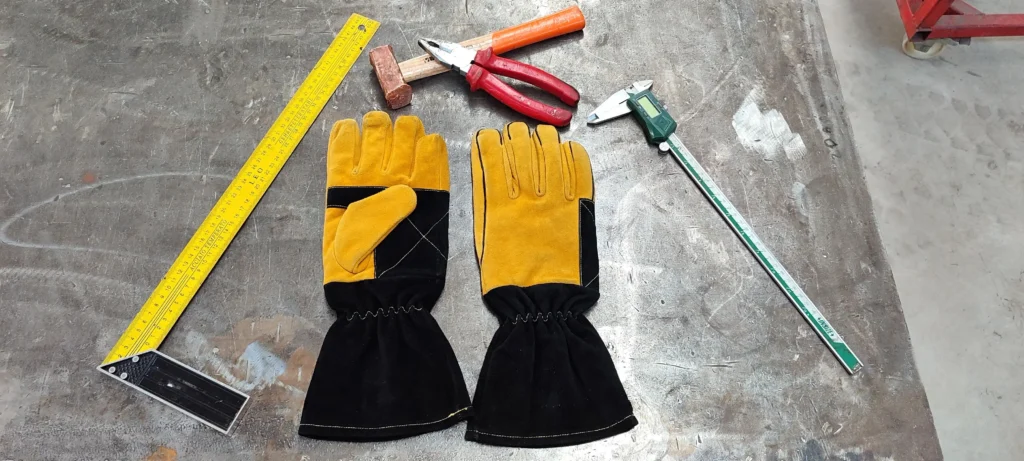
EN 407:2020 is the European standard used to evaluate protective gloves and other hand or arm protection against six thermal risks: limited flame spread, contact heat, convective heat, radiant heat, small molten-metal splashes, and large quantities of molten metal. Its six-position performance code reports each test separately, so the results must not be treated as one overall heat-protection score.
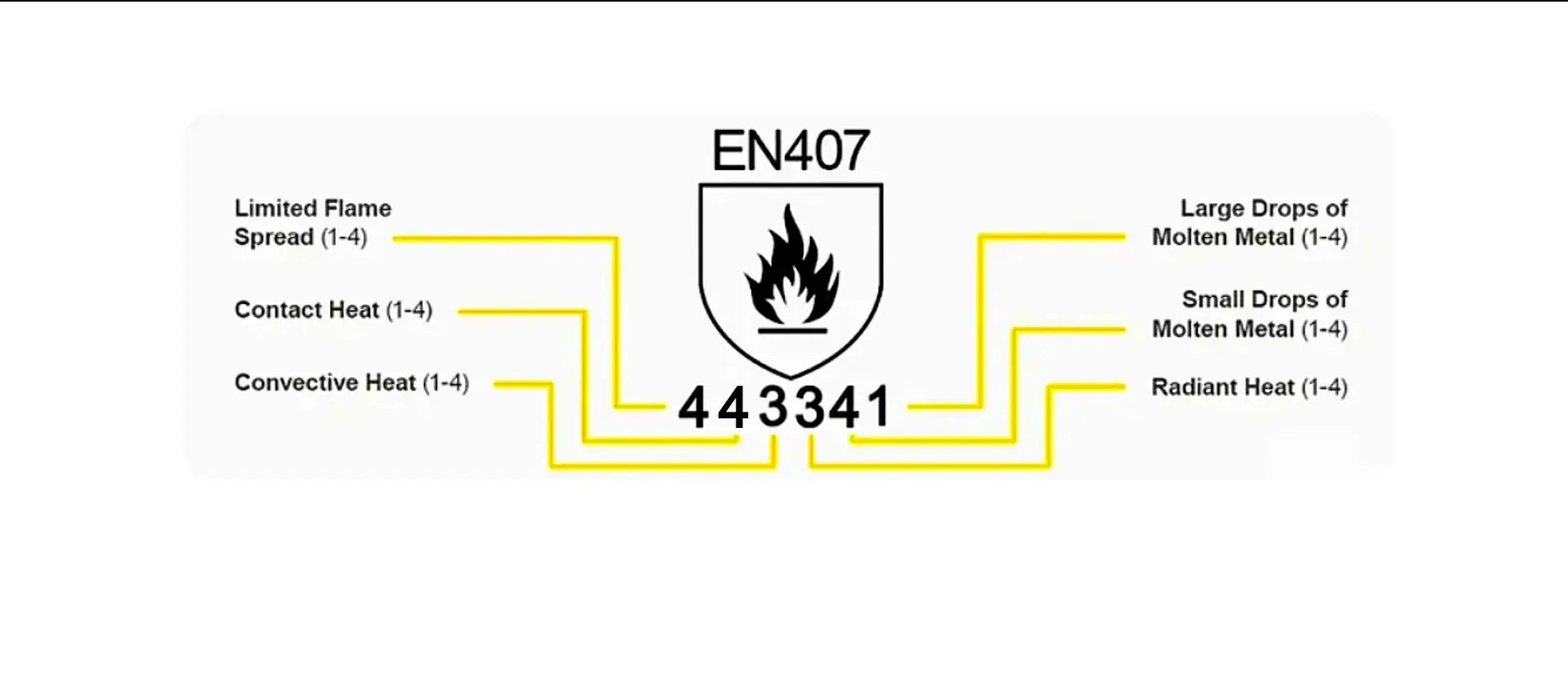
EN 407:2020 uses a six-position performance code to report how protective gloves and other hand protection perform against distinct thermal risks. Each position represents a separate laboratory test—limited flame spread, contact heat, convective heat, radiant heat, small molten-metal splashes, or large molten-metal exposure—and must be interpreted independently.
Expert tip:
Threshold time is the time required during the contact-heat test for the measuring calorimeter behind the tested material to rise by 10°C. Thermal transmission means heat passing through the material or tested glove assembly. A glove assembly is the complete tested combination of layers, such as the outer material, reinforcement, insulation and lining.
EN 407:2020 is the European standard specifying performance requirements, laboratory test methods, classifications, marking and manufacturer information for protective gloves and other hand protection against thermal risks. It is applied with EN ISO 21420:2020, which covers general glove design, construction, innocuousness, comfort, marking and information rather than thermal performance itself.
Important distinction: An EN 407 performance level is a laboratory classification for one defined test. It is not a general guarantee of protection against every source of heat or fire.
Terms such as heat-resistant gloves, high-temperature gloves and thermal protection gloves describe a general product purpose, but they do not identify the exact hazard tested or the performance achieved. EN 407 provides a structured, model-specific performance code that communicates separately declared results for flame, heat and molten-metal exposure.
This distinction helps safety professionals and industrial buyers compare protective gloves using defined test evidence rather than relying on an advertised temperature, material description or unsupported phrase. The ratings must still be considered alongside the product’s intended application, manufacturer information and workplace risk assessment.
EN 407:2020 applies to protective gloves and other hand or arm protection intended for defined thermal risks, including heat, flame, and molten-metal exposure. Its scope is limited to thermal performance: it does not assess mechanical, chemical, cold, or electrical protection, and its results apply only to the tested glove assembly and declared test positions.
EN 407:2020 covers protective gloves and other hand-protection equipment intended to protect all or part of the hand against one or more defined thermal hazards. It applies to products intended for professional, consumer, and domestic use and can also apply to arm-protection equipment within the standard’s scope.
EN 407 evaluates thermal risks only. It does not determine performance against mechanical, chemical, cold, or electrical hazards, and it does not establish complete suitability for welding or firefighting. Those hazards and applications are addressed through other product-specific or hazard-specific standards.
Important limitation: An EN 407 performance level reports laboratory performance for one specific thermal test. It does not prove protection against hazards outside that test position or guarantee performance in every workplace condition.
Specialist tip: Check the complete model-specific EN 407 code and manufacturer documentation. Compliance of one material or component does not automatically establish the performance of the complete glove assembly.
The EN 407:2020 performance code is read from left to right beneath the applicable thermal-risk pictogram. Each of its six positions represents a separate laboratory test. A position may contain a declared performance level from 1 to 4, an X where no level is claimed, or a 0 where Level 1 was not achieved.
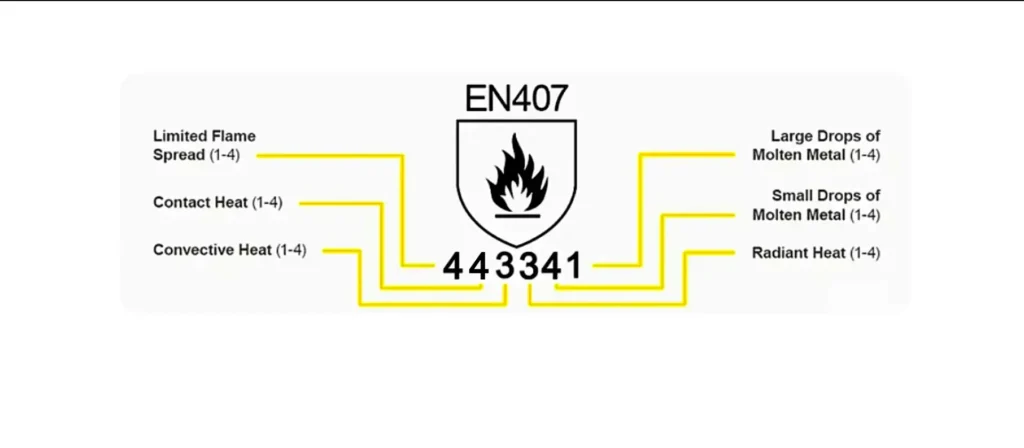
The six-character code always follows the same order. Letters A–F may be used in educational diagrams to identify the positions, but buyers must interpret the actual number, X, or 0 printed beneath the pictogram.
EN 407:2020 identifies six thermal properties in this fixed order. Only tests relevant to the product’s intended use need to be carried out, so some positions may not contain a declared numerical level.
EN 407:2020 uses two alternative thermal-risk pictograms. The pictogram containing a flame is used when the product claims at least Level 1 for limited flame spread. The heat-only or hot-contact pictogram is used when no limited flame-spread level is claimed. The two pictograms must not appear together on the same marking.
X means that no performance level is declared for that EN 407 test position. The test may not have been carried out, may not have been relevant or applicable to the product’s intended use, or the manufacturer may not claim performance for that property. X is not a numerical rating and should not automatically be interpreted as a failed test.
Buyers should consult the manufacturer’s instructions and model-specific documentation to determine why X appears and whether the unclaimed thermal property is relevant to the workplace risk assessment.
A 0 means that the relevant test was performed but the product did not achieve the minimum requirement for Level 1 in that position. Unlike X, which indicates that no performance level is declared, 0 records that the lowest numerical classification was not reached under the applicable laboratory test conditions.
A zero must not be treated as thermal protection. Buyers should determine whether that test area is relevant to the intended task before selecting the product.
Specialist note: The code 4132XX is an educational example. It must not be described as an ARASWELD model-specific performance code unless the exact glove model, EN 407 edition, test documentation, certificate, and EU Declaration of Conformity verify those results.
EN 407:2020 uses six separate laboratory tests to classify protection against flame, contact heat, convective heat, radiant heat, and molten-metal exposure. Each test uses different equipment, measurements, thresholds, and classification criteria. Therefore, a Level 4 result in one code position cannot be directly compared with Level 4 in another position or treated as an overall heat-protection score.
Important EN 407:2020 rule: To declare Level 3 or Level 4 for contact heat, convective heat, radiant heat, small molten-metal splashes, or large quantities of molten metal, the product must also achieve at least Level 3 for limited flame spread. Otherwise, the highest reportable result for that property is Level 2.
Limited flame spread measures how long the tested glove continues to flame or glow after a controlled ignition source is removed. It also examines melting, hole formation, seam integrity, and flaming debris. A numerical rating reports defined laboratory behaviour only; it does not mean the glove is fireproof, non-combustible, or suitable for every flame-exposure condition.
Contact heat resistance measures thermal transmission through the tested glove assembly when it touches a heated surface. The test records the threshold time required for the calorimeter behind the material to rise 10°C above its starting temperature. EN 407 classifies performance at test temperatures from 100°C to 500°C, with a minimum threshold time of 15 seconds.
The tested material or glove assembly is placed against a heated cylinder at the specified temperature. A calorimeter measures heat passing through the layers. The threshold time ends when the calorimeter temperature has increased by 10°C. The laboratory result depends on the tested materials, reinforcement, insulation, lining, contact temperature, and complete construction—not only the outer leather or fabric.
EN 407 contact heat Level 4 means the tested glove assembly achieved a threshold time of at least 15 seconds during laboratory contact with a surface heated to 500°C. It does not mean the wearer can safely hold every 500°C object for 15 seconds, because workplace protection also depends on pressure, surface area, conductivity, glove condition, and construction.
No. A 500°C contact-heat result is a laboratory classification, not a continuous-use temperature rating. Real-world heat transfer can change according to contact duration, pressure, object size, metal conductivity, insulation, lining, moisture, wear, contamination, and manufacturer limitations. Repeated contact may also allow heat to accumulate inside the glove even when each individual exposure is brief.
Convective heat resistance measures heat transmitted through the glove when the tested material is exposed to flame or hot gases. Performance is classified using the heat-transfer index, measured in seconds. A longer index indicates a greater delay before the defined quantity of heat passes through the tested assembly, but it does not measure direct hot-surface contact or radiant heat.
Radiant heat resistance measures how effectively the tested material delays thermal energy emitted by a hot source without direct contact. The classification is based on heat-transfer time under controlled radiant exposure. Reflective surfaces, insulation, material thickness, and complete glove construction can affect performance. The result must be interpreted separately from contact-heat and convective-heat ratings.
Radiant heat reaches the glove from a hot source without direct physical contact, while contact heat passes through the glove from a surface being touched. Because these tests use different heat-transfer mechanisms and procedures, a glove may achieve a strong radiant-heat result but a lower contact-heat result, or the reverse. Both ratings must be checked when both hazards are present.
The small molten-metal splash test measures the number of standardized molten droplets required to raise the temperature behind the tested material by 40°C. A higher level requires a greater number of droplets. The test represents repeated localized molten-metal exposure and should not be treated as a general rating for sparks, grinding debris, or every type of welding spatter.
The large molten-metal test evaluates how much molten iron can contact the tested material before a defined change occurs in a PVC skin-simulant placed behind it. It also examines ignition, melting, holes, and material-system behaviour. The result applies to the standardized molten-iron test conditions and does not establish identical performance against every metal or alloy.
EN 407:2020 performance levels must be interpreted within the specific test position where they appear. Contact heat, convective heat, radiant heat, flame behaviour, and molten-metal resistance use different laboratory procedures and measurements. The complete six-position code provides a thermal-performance profile, but it is not one overall score and must be matched to the workplace risk assessment.
No. EN 407 levels from different code positions are not directly comparable. Level 4 contact heat is based on performance against a heated surface, while Level 4 radiant heat measures heat-transfer delay under radiant exposure. Molten-metal classifications use different criteria again. Identical numbers therefore represent different test methods, thresholds, units, and thermal hazards—not equivalent degrees of protection.
No. Level 4 is only the highest classification available within the specific EN 407 test position where it appears. A glove rated Level 4 for contact heat may have lower, undeclared, or unsuccessful results for flame spread, radiant heat, convective heat, or molten metal. It must not be described as providing the highest overall thermal protection.
EN 407 classifications report performance under controlled laboratory conditions using defined temperatures, exposure periods, test surfaces, pressure, and new specimens. Real workplaces may involve repeated exposure, changing temperatures, different metals, variable handling pressure, contamination, moisture, damaged seams, or worn insulation. These conditions can produce different heat-transfer behaviour from the conditions represented by the original laboratory test.
Specialist note: EN 407 reports controlled laboratory performance. It does not guarantee unlimited protection in every workplace condition. Inspect the glove before use and verify the complete model-specific code, intended application, tested protection area, and manufacturer limitations.
EN 407 glove selection should begin with the specific thermal hazard, not only the industry or job title. Direct contact with hot objects, flame, heated gases, radiant energy, and molten metal are evaluated through different test positions. The required rating must reflect the exposure temperature, duration, frequency, material, and conditions identified in the workplace risk assessment.
Specialist note: Do not describe one EN 407 performance code as suitable for an entire industry. The required test positions and levels must match the exact task, intended application, and workplace risk assessment.
EN 407:2020 superseded the 2004 technical edition and revised the standard’s scope, test provisions, mechanical-strength requirements, marking, manufacturer information, and annexes. The 2020 edition also added coverage for other hand-protection equipment and introduced a new pictogram. Buyers must check the exact edition declared in the model-specific documentation.
Key point: The pictogram identifies the type of thermal claim, while the six-position code identifies the individual declared performance results.
EN 407 testing produces thermal performance classifications, while CE marking and certification relate to the broader conformity-assessment requirements of PPE Regulation (EU) 2016/425. A laboratory result, performance code, EU type-examination certificate, EU Declaration of Conformity, and CE marking are connected documents or processes, but they are not the same thing.
EN 407 testing supports thermal-performance classification, while CE marking and conformity assessment are governed by PPE Regulation (EU) 2016/425.
CE marking indicates that the manufacturer declares the PPE complies with the applicable requirements of EU legislation, including PPE Regulation (EU) 2016/425. It does not mean that every EN 407 test achieved a numerical level, that the glove protects against every thermal hazard, or that protection is unlimited. Buyers must still inspect the complete performance code, category, documentation, and intended application.
PPE category is determined by the risk against which the product is intended to protect—not simply by the presence of an EN 407 marking. Category II covers risks not included in Categories I or III. Category III covers defined risks that may cause death or irreversible damage to health, including qualifying high-temperature environments.
Specialist note: A certificate belonging to one glove model, material, or product family should not automatically be applied to another model. The model identifier, declared performance code, standard edition, and supporting conformity documents must agree.
Specialist tip: Select the glove from the complete hazard profile, model-specific documentation, construction, condition, and intended application—not from one number or the phrase “heat-resistant gloves.”
EN 407 ratings are often misread as overall protection scores, continuous-use temperatures, or proof of suitability for every heat-related task. In reality, each code position represents a separate laboratory test. The complete code, exact model documentation, glove condition, intended use, and workplace risk assessment must all be considered before selecting protective gloves.
Compare heat-resistant gloves using the exact model-specific EN 407 code, declared standard edition, tested area, construction, intended use, and supporting documentation. Do not compare models from one isolated level or an advertised temperature. Two gloves with the same contact-heat level may differ in flame behaviour, radiant heat, molten-metal performance, coverage, dexterity, lining, and manufacturer limitations.
Welding-glove buyers should not rely on EN 407 alone. EN 12477 specifically addresses protective gloves for manual metal welding, cutting, and allied processes, while relevant EN 407 and EN 388 results describe parts of the thermal and mechanical performance profile. Buyers must also evaluate glove construction, coverage, dexterity, welding process, exposure level, and model-specific documentation.