EN 407 Standard Full Explained: Heat Resistance Tests,Ratings,Comparison tables & Glove Protection

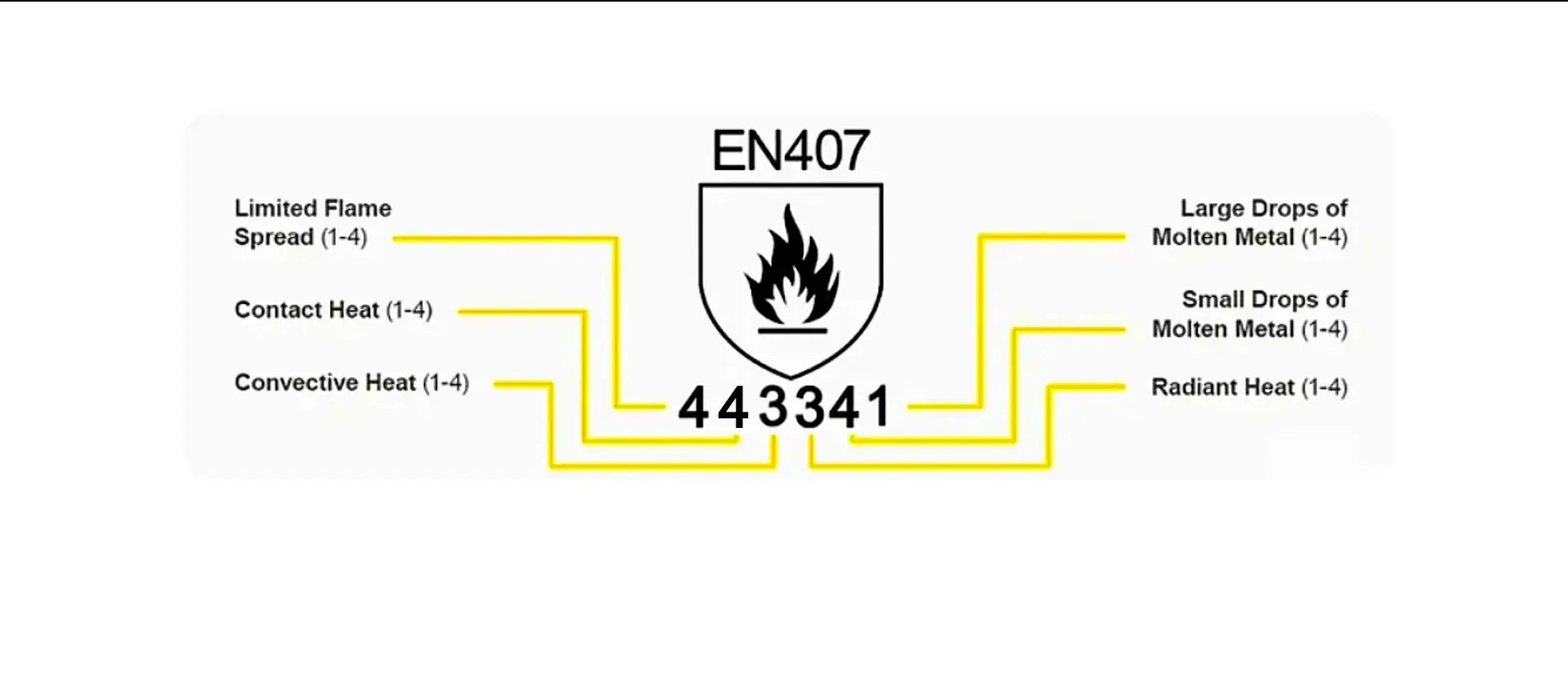
EN 407 thermal safety standard shield diagram showing heat resistance ratings for limited flame spread, contact heat, convective heat, radiant heat, and small or large molten metal splashes.

The EN 407 standard establishes mandatory guidelines and uniform test criteria for protective gloves against thermal risks. This analytical study includes structural comparison tables detailing test protocols for:

  • Limited Flame Spread: Evaluating afterflame and afterglow material behavior.

  • Heat Transfer Dynamics: Measuring contact heat transfer, convective heat, and radiant heat thresholds.

  • Molten Metal Protection: Quantifying resistance against both small and large splashes.

This comprehensive documentation covers a complete breakdown of performance levels, standard performance criteria, and individual material behavior properties to help you select or verify certified thermal glove specifications accurately.

What Is EN 407?

EN 407 is a European safety standard that defines how protective gloves are tested and rated for resistance to heat and fire-related risks.

It evaluates gloves used in high-temperature environments by measuring their performance against hazards such as flame exposure, contact heat, radiant heat, and molten metal splashes.

The standard is widely used in industries where workers handle hot materials or are exposed to thermal dangers, ensuring gloves provide verified and comparable levels of protection.

Definition of EN 407

EN 407 is a European standard specifically designed to assess the thermal protection performance of safety gloves exposed to heat and flame hazards.

It applies to protective gloves used in environments where workers may encounter direct flame, high temperatures, or molten metal.

The standard ensures that gloves are tested under controlled conditions and assigned performance levels, allowing users to choose the right level of protection based on their specific work risks.

Expert point

EN 407 applies to gloves exposed to:

  • Flame exposure
  • Contact and radiant heat
  • Convective heat (hot air transfer)
  • Molten metal splashes

What Does “Thermal Risk” Mean?

Thermal risk refers to any workplace hazard caused by heat, flame, or high-temperature materials that can damage skin or protective equipment.

In the context of EN 407, thermal risks include different types of heat transfer and fire exposure that gloves must resist to protect the wearer. Understanding these risks helps users select gloves with the correct performance levels for their specific working conditions.

Expert point

In EN 407, thermal risks include:

  • Contact heat – direct touch with hot surfaces
  • Radiant heat – heat emitted from hot objects or flames
  • Convective heat – heat carried by hot air or gases
  • Flame exposure – direct contact with fire

What Industries Use EN 407?

EN 407 is used across industries where workers are exposed to heat, flames, or molten materials, making it essential for selecting safe and compliant protective gloves.

These industries rely on EN 407 ratings to ensure workers are properly protected against specific thermal hazards, reducing the risk of burns and workplace injuries.

Expert point

Common industries that use EN 407 gloves include:

  • Welding – exposure to sparks, flame, and high heat
  • Foundry work – handling molten metal and extreme temperatures
  • Glass manufacturing – working with hot glass and radiant heat
  • Metal processing – cutting, forging, and heat treatment operations

EN 407 Pictogram Explained

The EN 407 pictogram is a standardized flame symbol used on protective gloves to display their heat and fire resistance performance in a simple visual format.

Next to the icon, a sequence of six numbers indicates the glove’s test results across different thermal hazards, allowing users to quickly interpret protection levels without reading technical reports.

EN 407 thermal safety standard shield diagram showing heat resistance ratings for limited flame spread, contact heat, convective heat, radiant heat, and small or large molten metal splashes.

What Does the EN 407 Symbol Look Like?

The EN 407 pictogram is a standardized flame symbol used to indicate that a protective glove has been tested for resistance to heat and fire hazards.

Next to the flame icon, a series of six numbers (or letters) appears, representing the glove’s performance levels across different thermal tests.

This visual marking allows users to quickly understand how well a glove protects against specific types of heat exposure.

How to Read EN 407 Ratings

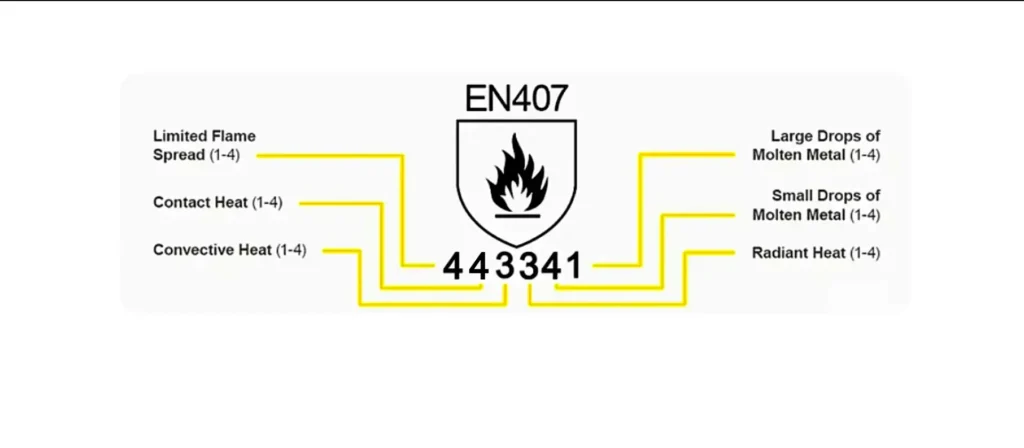
EN 407 ratings are displayed as a sequence of six values placed next to the flame pictogram, with each position representing a specific type of thermal protection test.

These values typically range from 0 to 4, where higher numbers indicate better resistance. If a test is not performed or not applicable, the letter “X” is used instead of a number.

Example rating:EN 407: 4 3 3 2 1 X

EN 407 thermal safety standard shield diagram showing heat resistance ratings for limited flame spread, contact heat, convective heat, radiant heat, and small or large molten metal splashes.

Each number in the EN 407 rating represents:

  • 1st value – Limited flame spread
  • 2nd value – Contact heat resistance
  • 3rd value – Convective heat resistance
  • 4th value – Radiant heat resistance
  • 5th value – Resistance to small molten metal splashes
  • 6th value – Resistance to large molten metal splashes

What Does “X” Mean in EN 407?

In EN 407 ratings, the letter “X” means that a specific test was not performed or the glove was not tested for that type of thermal protection.

It does not indicate failure, but rather that no performance level is available for that category. Users should be cautious when selecting gloves with “X” ratings, as it means protection against that hazard is unknown.

Why the EN 407 Pictogram Matters

The EN 407 pictogram provides a quick and standardized way to compare the heat resistance performance of different gloves without needing to review detailed test reports.

It helps safety managers, buyers, and workers select the appropriate level of protection based on real, tested data, reducing the risk of burns and workplace injuries.

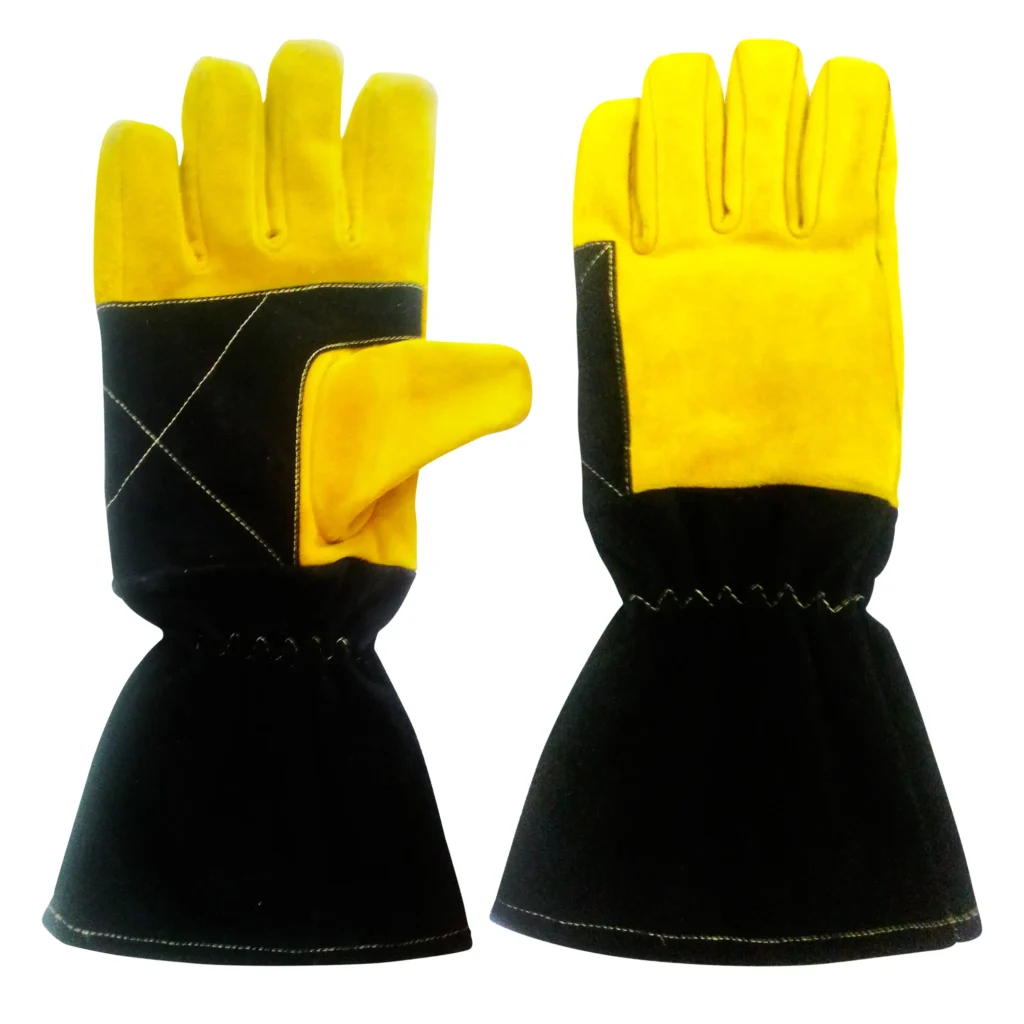
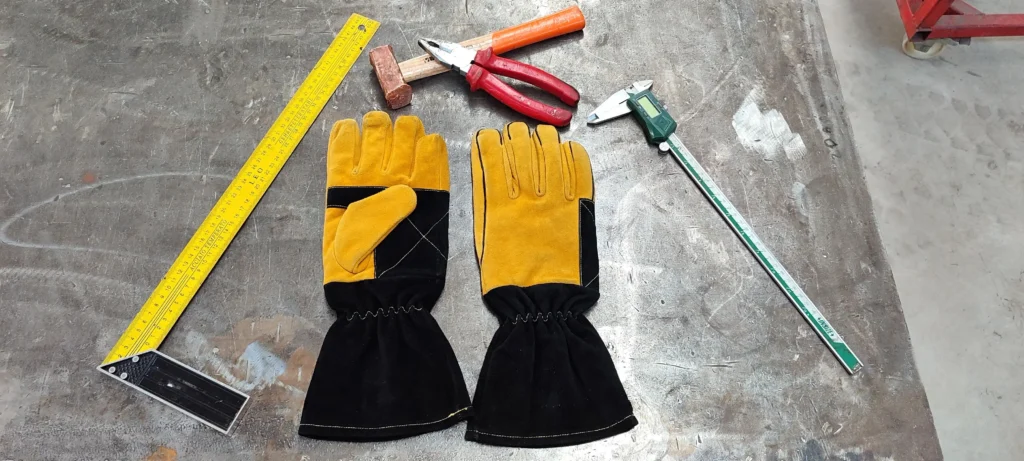
MIG welding gloves With high quality cowhide leather balanced dexterity and heat protection

EN 407 Tests and Performance Levels

EN 407 tests and performance levels define how protective gloves are evaluated against different types of heat and fire hazards using standardized laboratory methods.

Each glove is tested across six categories—such as flame resistance, contact heat, and molten metal splashes—and assigned a performance level from 0 to 4, where higher values indicate better protection.

The master table below provides a clear, side-by-side comparison of these levels, helping users quickly understand and select the appropriate glove for their specific thermal risk.

EN 407 Heat Resistance Tests and Performance Levels – Complete Overview of All Thermal Protection Ratings
Test Type Level 1 Level 2 Level 3 Level 4
Limited Flame Spread Basic resistance Improved resistance High resistance Maximum resistance
Contact Heat (°C) 100°C (≥15 sec) 250°C (≥15 sec) 350°C (≥15 sec) 500°C (≥15 sec)
Convective Heat (HTI) ≥4 sec ≥7 sec ≥10 sec ≥18 sec
Radiant Heat (RHTI) ≥7 sec ≥20 sec ≥50 sec ≥95 sec
Molten Metal (Small Splashes) ≥10 droplets ≥15 droplets ≥25 droplets ≥35 droplets
Molten Metal (Large Splashes) 30 g 60 g 120 g 200 g

Expert Bullet Points:

  • Provides a full comparison of all EN 407 heat resistance tests
  • Helps users quickly evaluate glove performance across multiple risks
  • Combines flame, heat, and molten metal protection in one view
  • Useful for selecting gloves based on specific industrial needs

This master table summarizes all EN 407 heat resistance tests and performance levels, allowing users to compare different types of thermal protection in one structured view. It helps identify the appropriate glove based on heat exposure risks and working conditions.

EN 407 Performance Levels Explained

EN 407 performance levels define how well a protective glove resists different types of heat and fire hazards, based on standardized laboratory tests.

Each test is rated on a scale from 0 to 4, where higher levels indicate better protection. These levels help users quickly compare gloves and select the appropriate protection for specific thermal risks.

EN 407 performance levels table for heat-resistant gloves

How to Interpret the EN 407 Levels

Each EN 407 level represents a measurable increase in protection, but higher levels do not always mean better for every situation.
Instead, the correct level depends on the specific type of heat exposure. For example, a glove with high contact heat resistance may not necessarily offer the same level of protection against molten metal splashes.

Key interpretation tips:

  • Higher numbers = better resistance in that specific test
  • Each test is independent (one high score does not cover all risks)
  • “X” means no test result is available
  • Always match glove ratings to your actual working conditions

Important Notes About EN 407 Testing

EN 407 testing is conducted under controlled laboratory conditions, which means real-world performance may vary depending on factors such as glove fit, wear, and environmental conditions.
Users should always consider the full risk environment rather than relying on a single performance level.

Important considerations:

  • Tests are performed on new, unused gloves
  • Results may differ after wear or contamination
  • Gloves must meet minimum requirements in some tests to be certified
  • EN 407 is often used together with other standards for full protection
ARASWELD heat-resistant welding gloves has EN 407 certification
EN 407 thermal safety standard shield diagram showing heat resistance ratings for limited flame spread, contact heat, convective heat, radiant heat, and small or large molten metal splashes.

Limited Flame Spread (EN 407 Test)

The EN 407 limited flame spread test measures how a glove material behaves when exposed to direct flame, focusing on ignition, burning duration, and self-extinguishing ability.

It ensures that the material does not continue to burn or glow excessively after the flame source is removed, making it a critical safety requirement for gloves used in high-heat and fire-risk environments such as welding and metalwork.

EN 407 safety standard laboratory test applying a direct gas burner flame to Arasweld leather welding glove to measure limited flame spread.
Glove material is exposed to a controlled flame to evaluate ignition and self-extinguishing behavior under EN 407 testing.

What Is Limited Flame Spread?

Limited flame spread is a test within EN 407 that measures how a glove material reacts when exposed to direct flame, specifically evaluating how quickly it ignites, burns, and self-extinguishes.

The test ensures that the glove does not continue burning or produce dangerous afterflame or afterglow once the ignition source is removed. This is a critical requirement for heat-resistant gloves used in high-risk environments such as welding and metalwork, where accidental flame exposure is common.

How the Limited Flame Spread Test Works

EN 407 limited flame spread performance levels range from Level 1 to Level 4 and are determined by strict limits on afterflame time, afterglow time, and overall material behavior during testing.

To achieve higher levels, the glove must extinguish quickly, avoid prolonged glowing, and maintain its structure without forming holes or producing burning debris.
These measurements determine whether the glove meets the minimum safety requirements and what performance level it achieves.

The test evaluates:

  • Afterflame time – how long the material continues burning after flame removal
  • Afterglow time – how long the material glows without flame
  • Burning debris – whether molten or flaming particles fall off
  • Hole formation – whether the material develops holes
diagram illustrating the operational testing EN 407 thermal resistance parameters.
The EN 407 flame spread test measures afterflame, afterglow, and material integrity after flame exposure.

EN 407 Limited Flame Spread Performance Levels

EN 407 limited flame spread performance levels range from Level 1 to Level 4 and are based on strict limits for afterflame and afterglow times, as well as material behavior during testing.

To achieve higher levels, the glove must extinguish quickly, avoid glowing, and maintain structural integrity without forming holes or producing burning debris.

EN 407 Limited Flame Spread Performance Levels – Afterflame, Afterglow, and Material Behavior Criteria
Performance Criteria Level 1 Level 2 Level 3 Level 4
Afterflame Time ≤ 20 sec ≤ 10 sec ≤ 3 sec ≤ 2 sec
Afterglow Time ≤ 120 sec ≤ 25 sec ≤ 5 sec ≤ 5 sec
Flaming Debris Allowed Not allowed Not allowed Not allowed
Hole Formation Allowed Not allowed Not allowed Not allowed

Expert Bullet Points:

  • Defines how quickly a glove stops burning after flame exposure
  • Higher levels require faster self-extinguishing behavior
  • Prevents dangerous risks like burning debris and hole formation
  • Critical for welding and fire-related environments

This table outlines the EN 407 limited flame spread performance criteria, including afterflame time, afterglow time, and material behavior.Higher levels indicate better flame resistance and safer performance under direct flame exposure.

Important Notes About Flame Resistance

Flame resistance in EN 407 does not mean the glove is completely fireproof, but rather that it meets specific performance criteria under controlled test conditions.

Real-world performance can vary depending on exposure time, temperature intensity, and glove condition, so users should always select gloves based on their actual working environment and risk level.

Key considerations:

  • Gloves must pass minimum flame test requirements to be certified
  • Higher levels provide better resistance but not unlimited protection
  • Flame resistance is only one part of overall thermal protection
  • Should be used together with other EN standards when needed
STICK welding gloves With high quality cowhide leather Kevlar-stitched directly impacts heat insulation and finger control
EN 407 certified gloves are commonly used in welding environments where flame and heat exposure are frequent.

Contact Heat Resistance (EN 407 Test)

What Is Contact Heat Resistance?

Contact heat resistance in EN 407 measures how well a glove can protect the wearer when directly touching hot surfaces at specific temperatures.

The test evaluates how long the glove can delay heat transfer before the inner side reaches a pain threshold, ensuring the user has enough time to react safely.
This makes it one of the most important performance indicators for gloves used in welding, metal handling, and other high-temperature industrial applications.

showing glove EN 407 heat resistance exposed to radiant heat from molten metal source and spark resistance proof.arasweld gloves
Contact heat resistance measures how long a glove can protect the hand when touching hot surfaces.

How the Contact Heat Test Works

The contact heat test is performed according to EN ISO 12127-1, where a glove material is placed in contact with a heated surface at a defined temperature.

The time is measured until the inner side of the glove increases by 10°C, which represents the limit before the user feels pain. To pass a specific level, the glove must withstand the temperature for at least 15 seconds without exceeding this threshold.

The test measures:

  • Surface temperature exposure (100°C to 500°C)
  • Time to heat transfer (minimum 15 seconds required)
  • Thermal insulation performance of the material

EN 407 Contact Heat Performance Levels

EN 407 contact heat performance levels range from Level 1 to Level 4 and indicate the maximum temperature a glove can handle for at least 15 seconds without causing pain.

Higher levels provide greater protection against hot surfaces, making them suitable for more extreme industrial conditions.

Level Temperature Minimum Time
Level 1 100°C ≥ 15 seconds
Level 2 250°C ≥ 15 seconds
Level 3 350°C ≥ 15 seconds
Level 4 500°C ≥ 15 seconds

EN 407 contact heat levels from 100°C to 500°C comparison

What Contact Heat Levels Mean in Real Life

EN 407 contact heat levels help users understand how gloves perform in real working conditions by translating test results into practical heat exposure limits.

Choosing the correct level ensures that workers are protected for the necessary duration when handling hot materials.

Real-world examples:

  • Level 1 (100°C) → light industrial tasks, warm surfaces
  • Level 2 (250°C) → general welding and metal handling
  • Level 3 (350°C) → heavy industrial heat exposure
  • Level 4 (500°C) → extreme heat environments like foundries
Real world examples of EN 407 contact heat levels in different industries
Different EN 407 contact heat levels correspond to specific industrial applications and heat exposure risks

Convective Heat Resistance (EN 407 Test)

Convective heat resistance in EN 407 evaluates how well a glove protects against heat transferred through hot gases or air, such as flames or heated airflow.

This test measures how long the glove can delay heat penetration when exposed to a continuous heat source.

Higher levels indicate stronger insulation against moving heat, which is essential in environments like welding, foundries, and firefighting where hot air and flames are constantly present.

EN 407 convective heat resistance test showing glove exposed to flame and hot airflow
Convective heat resistance protects against heat carried by flames and hot gases in industrial environments.

EN 407 Convective Heat Performance Levels

EN 407 convective heat performance levels range from Level 1 to Level 4 and are based on how long a glove can resist heat transfer from flames or hot air before the inside temperature rises.

Gloves with higher levels provide longer protection times, making them more suitable for high-risk environments where continuous exposure to heat and flames is expected.

EN 407 Convective Heat Resistance – Heat Transfer Delay Time
Performance Level Heat Transfer Time (seconds) Protection Level
Level 1 > 4 seconds Basic protection
Level 2 > 7 seconds Moderate protection
Level 3 > 10 seconds High protection
Level 4 > 18 seconds Maximum protection

Key Factors in Convective Heat Resistance:

  • Measures heat transfer from flames or hot gases
  • Higher levels = longer protection time
  • Essential for welding and furnace work
  • Works together with flame resistance rating

Radiant Heat Resistance (EN 407 Test)

Radiant heat resistance in EN 407 measures how well a glove protects against heat emitted in the form of thermal radiation, rather than direct contact or flame.

This test evaluates how long the glove can delay heat transfer when exposed to a radiant heat source, such as molten metal glow or intense industrial heat.
Higher performance levels indicate longer protection time, making this test essential for welding, foundry work, and high-temperature industrial environments.

showing glove EN 407 heat resistance exposed to radiant heat from molten metal source and spark resistance proof.arasweld gloves
Radiant heat resistance protects against heat emitted from high-temperature sources without direct contact.

EN 407 Radiant Heat Performance Levels

EN 407 radiant heat performance levels range from Level 1 to Level 4 and are based on how long a glove can resist heat transfer from radiant sources before the internal temperature rises.

Gloves with higher ratings provide extended protection in environments where intense heat is constantly emitted, such as welding arcs and industrial furnaces.

EN 407 Radiant Heat Resistance Levels – Heat Transfer Time
Performance Level Heat Transfer Time (seconds) Protection Level
Level 1 > 7 seconds Basic protection
Level 2 > 20 seconds Moderate protection
Level 3 > 50 seconds High protection
Level 4 > 95 seconds Maximum protection

Key Factors in Radiant Heat Resistance:

  • Protects against heat without direct contact
  • Critical in welding arcs and furnaces
  • Higher levels = longer exposure tolerance
  • Works together with convective and contact heat ratings

Molten Metal Splash Resistance (EN 407 Test)

Molten metal splash resistance in EN 407 evaluates how well a glove can protect against droplets or splashes of molten metal.

The test measures how many molten metal droplets are required to raise the glove’s internal temperature to a pain threshold level.
This makes it one of the most critical safety indicators for welders, as it directly reflects real-world exposure to sparks and molten particles.

EN 407 molten metal splash showing welding sparks hitting protective glove
Molten metal resistance measures how well gloves protect against welding sparks and hot metal splashes.

Small Molten Metal Splash (Performance Levels)

The small molten metal splash test in EN 407 measures how many molten metal droplets a glove can withstand before the internal temperature reaches a pain threshold.

Higher levels indicate stronger resistance to welding sparks and small metal splashes, making them essential for daily welding tasks.

EN 407 Small Molten Metal Splash Performance Levels – Number of Droplets Resistance
Performance Level Number of Droplets Protection Level
Level 1 > 10 droplets Basic protection
Level 2 > 15 droplets Moderate protection
Level 3 > 25 droplets High protection
Level 4 > 35 droplets Maximum protection

What This Table Shows:

  • Indicates how many molten metal droplets the glove can withstand before reaching a pain threshold
  • Higher performance levels mean greater resistance to welding sparks and hot metal splashes
  • Level 3–4 gloves are recommended for frequent welding and high-risk environments
  • Helps users quickly compare real-world spark protection performance
  • Essential for selecting gloves for MIG, TIG, and ARC welding applications

This table summarizes the EN 407 small molten metal splash performance levels, showing how many molten droplets each level can resist before causing heat discomfort.
Gloves with higher ratings provide better protection against welding sparks and are more suitable for intensive industrial applications.

Large Molten Metal Splash (Performance Levels)

The large molten metal splash test evaluates how much molten metal mass a glove can resist before causing damage to a simulated skin surface.

Unlike small splashes, this test reflects extreme industrial risks and is especially important in foundries and heavy metal casting operations.

Performance Level Molten Metal (grams) Protection Level
Level 1 30 g Basic protection
Level 2 60 g Moderate protection
Level 3 120 g High protection
Level 4 200 g Maximum protection

Key Factors in Molten Metal Resistance:

  • Measures real welding risk (sparks + splashes)
  • Small splashes = daily welding safety
  • Large splashes = extreme industrial protection
  • Higher levels = greater burn prevention
  • Critical for MIG, TIG, ARC welding environments
showing glove EN 407 heat resistance exposed to radiant heat from molten metal source and spark resistance proof.arasweld gloves

What EN 407 Levels Mean in Real Life

EN 407 performance levels translate laboratory test results into real-world protection levels, helping users understand how gloves perform under different thermal risks.

Defined by the European Committee for Standardization and based on standardized methods such as EN ISO 12127-1, EN ISO 9151, and EN ISO 6942, these levels indicate how long or how well a glove resists heat, flame, and molten metal exposure.

Understanding these levels is essential for selecting the right gloves for specific industries, ensuring both safety compliance and effective protection in real working environments.

EN 407 Performance Levels Explained in Real-World Applications
Level Protection Meaning Typical Use Case
Level 1 Basic protection against low heat exposure Light-duty tasks with minimal thermal risk
Level 2 Moderate resistance to heat and occasional contact General industrial applications
Level 3 High protection against sustained heat exposure Heavy-duty industrial and welding environments
Level 4 Maximum resistance to extreme heat and hazards Foundry, metal casting, and extreme heat conditions
  • EN 407 levels range from 1 (basic protection) to 4 (maximum heat resistance)
  • Higher levels indicate longer protection time and higher temperature tolerance
  • Each level is based on standardized lab testing, not assumptions
  • Gloves may have different levels across different tests (not one single rating)
  • Always match glove level to the specific thermal hazard in your work environment

EN 407 levels help users quickly understand how protective gloves perform under real heat and flame conditions.
Level 1 provides basic protection for low-risk tasks, while Level 4 offers maximum resistance for extreme environments such as foundries and metal casting.
These levels are determined through standardized testing and should always be matched to the specific thermal hazards present in the workplace.

Practical Interpretation

Each EN 407 level represents a measurable increase in thermal protection, based on controlled laboratory testing that simulates real exposure conditions.
These levels are not arbitrary—they reflect thresholds for heat transfer, flame resistance, and material durability under standards like EN ISO 15025. As the level increases from 1 to 4, the glove provides longer resistance time, higher temperature tolerance, and greater protection against hazards such as direct contact heat, radiant energy, and molten metal splashes.

Example Scenarios

Different industries require different EN 407 performance levels depending on the type and intensity of thermal exposure. By aligning glove ratings with real-world applications, workers can select appropriate protection based on tested resistance to flame, heat transfer, and molten metal hazards.

  • Welding gloves → Require high flame resistance and moderate to high heat protection (Levels 2–4)
  • Foundry gloves → Need maximum protection against molten metal splashes and extreme heat (Level 4)
  • Glass handling → Requires strong contact and radiant heat resistance for handling hot materials (Levels 2–3)

EN 407 molten metal splash showing welding sparks hitting protective glove
ARASWELD heat-resistant welding gloves has EN 407 certification
EN 407 convective heat resistance test showing glove exposed to flame and hot airflow

Want to know more about welding gloves? You can see this complete article on welding gloves guide.

EN 407 vs EN 388

EN 407 and EN 388 are two essential European standards for protective gloves, each addressing different types of workplace hazards.

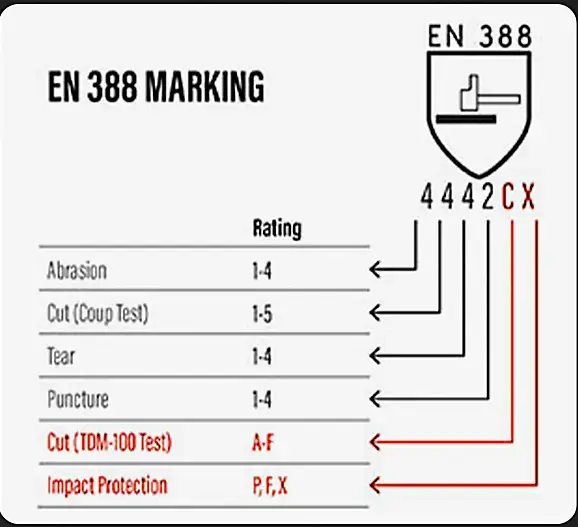
Defined by the European Committee for Standardization, EN 407 focuses on thermal risks such as heat, flame, and molten metal, while EN 388 evaluates mechanical risks including abrasion, cut, tear, and puncture resistance.
These standards use different test methods—such as EN ISO 15025 for flame resistance and EN 388 abrasion test—to ensure gloves provide reliable protection in specific hazard conditions.
Understanding the difference between these standards is critical for selecting gloves that meet both safety requirements and real-world job demands.

Key Differences

The main difference between EN 407 and EN 388 lies in the type of hazards they assess and the testing criteria used.

EN 407 measures thermal performance through heat and flame exposure tests, while EN 388 evaluates physical durability through mechanical stress tests.
Since many industrial environments involve both heat and physical risks, these standards often complement each other rather than compete.

EN 407 vs EN 388 – Key Differences in Glove Protection Standards
Criteria EN 407 (Thermal Protection) EN 388 (Mechanical Protection)
Primary Risk Type Heat, flame, molten metal Abrasion, cut, tear, puncture
Key Test Methods Flame spread, contact heat, radiant heat Abrasion resistance, blade cut, tear strength
Performance Levels Levels 1–4 (thermal resistance) Levels 1–4/5 (mechanical resistance)
Typical Industries Welding, foundry, glass, metalwork Construction, manufacturing, logistics
Purpose Protect against thermal hazards Protect against physical/mechanical hazards
  • EN 407 is designed for thermal risks such as heat, flame, and molten metal
  • EN 388 focuses on mechanical hazards like cuts, abrasion, and punctures
  • The two standards use completely different testing methods and rating systems
  • Gloves can be certified under both standards simultaneously
  • Choosing the right glove depends on identifying all workplace hazards

EN 407 and EN 388 serve different purposes in glove protection.
EN 407 measures resistance to heat and flame, while EN 388 evaluates protection against mechanical risks like cuts and abrasion.

In many industrial environments, both standards are required to ensure complete hand protection against combined hazards.

When You Need Both Standards

In many real-world applications, workers are exposed to both thermal and mechanical hazards at the same time.

Industries such as welding, metal fabrication, and heavy manufacturing often require gloves that meet both EN 407 and EN 388 standards to ensure comprehensive protection.
For example, a welding glove must resist high temperatures and flame exposure (EN 407) while also providing durability against sharp edges and rough materials (EN 388).
Selecting dual-certified gloves ensures compliance with safety regulations and reduces the risk of injury in complex work environments.

  • Welding → heat + sparks + sharp metal edges
  • Metal fabrication → hot surfaces + abrasion risks
  • Glass industry → high heat + cut hazards
  • Heavy industry → combined thermal and mechanical exposure

Certification and Testing Process

The EN 407 certification and testing process ensures that protective gloves meet strict European safety requirements for thermal risks.

Governed by the PPE Regulation (EU) 2016/425 and standardized by the European Committee for Standardization, gloves are tested using validated methods such as EN ISO 15025 and EN ISO 12127-1.

These tests evaluate performance under controlled conditions to assign protection levels, ensuring gloves are safe, reliable, and compliant for industrial use. Only certified products can carry CE marking, confirming they meet EU safety and quality standards.

Certification Bodies

Certification bodies, also known as notified bodies, are independent organizations authorized to test and verify that protective gloves comply with EN 407 and other relevant standards.

These organizations conduct laboratory testing, audit manufacturing processes, and issue official certificates required for CE marking under EU regulations. Choosing gloves certified by recognized bodies ensures credibility, traceability, and compliance with international safety benchmarks.

Recognized Certification Bodies for EN 407 Protective Gloves
Certification Body Role Scope of Testing
Intertek Independent testing and certification PPE compliance, thermal and mechanical testing
SGS Global inspection and verification services Product testing, certification, quality assurance
TÜV Technical inspection and certification authority Safety certification, compliance audits, lab testing
  • Certification bodies perform independent testing and verification
  • They ensure gloves meet EN 407 and EU safety requirements
  • Testing includes thermal resistance, durability, and material safety
  • Only approved bodies can issue certificates for CE marking
  • Choosing certified gloves improves safety and regulatory compliance

Certification bodies such as Intertek, SGS, and TÜV test and verify protective gloves to ensure compliance with EN 407 standards.

These organizations conduct independent laboratory testing and issue certification required for CE marking, confirming that gloves meet European safety and performance requirements.

  • Intertek → Independent product testing and certification
  • SGS → Global verification and quality assurance
  • TÜV → Safety certification and compliance audits

CE Marking Explained

CE marking is a mandatory conformity mark that indicates a product meets the essential health, safety, and environmental protection requirements set by the European Union.

Under PPE Regulation (EU) 2016/425, gloves certified to EN 407 must undergo testing by a notified body before receiving CE marking.This process includes performance evaluation, technical documentation review, and ongoing quality control.

The CE mark assures users that the gloves have been independently tested and comply with all applicable EU standards for protective equipment.

  • CE marking confirms compliance with EU safety regulations
  • Required for all PPE sold in the European market
  • Indicates third-party testing and certification
  • Includes ongoing quality control and factory audits
  • Essential for legal sale and workplace safety compliance
intertek.logo
sgs.logo
tuv. logo

How to Choose EN 407 Gloves

Choosing the right EN 407 gloves depends on matching glove performance levels to the specific thermal hazards present in your work environment.

Defined under the European Committee for Standardization and regulated by PPE Regulation (EU) 2016/425, EN 407 ratings are based on standardized tests such as EN ISO 15025 and EN ISO 12127-1.

To select the correct gloves, users must evaluate both the industry requirements and the level of heat, flame, or molten metal exposure to ensure proper protection, compliance, and long-term safety.

Based on Industry

Different industries expose workers to different types of thermal hazards, which means glove selection must align with specific risks such as flame exposure, radiant heat, or molten metal splashes.

EN 407 performance levels help identify the appropriate protection required for each application, ensuring gloves meet both safety standards and operational demands.

How to Choose EN 407 Gloves Based on Industry Requirements
Industry Main Hazard Recommended EN 407 Protection
Welding Flame, sparks, high heat High flame resistance + contact heat (Levels 3–4)
Foundry Molten metal splashes, extreme heat Maximum molten metal + radiant heat (Level 4)
General Industry Moderate heat and occasional exposure Balanced protection across tests (Levels 2–3)
Glass Handling High contact and radiant heat Strong contact + radiant heat resistance (Levels 2–3)
  • Welding requires high flame and heat resistance
  • Foundry work demands maximum molten metal protection
  • Industrial tasks need balanced thermal protection
  • Glass handling focuses on contact and radiant heat resistance
  • Matching glove type to industry improves safety and compliance

Choosing EN 407 gloves based on industry ensures the right level of thermal protection. Welding requires high flame resistance, foundry work demands maximum molten metal protection, and general industrial tasks need balanced heat resistance.

Selecting gloves according to specific hazards improves safety and ensures compliance with EN 407 standards.

Required Points

  • Welding → high flame + heat (Levels 3–4)
  • Foundry → molten metal resistance (Level 4)
  • Industrial → balanced protection (Levels 2–3)

Based on Risk Level

In addition to industry type, selecting EN 407 gloves requires evaluating the level of thermal risk involved in specific tasks. Risk levels are determined by factors such as temperature exposure, duration of contact, and presence of flame or molten metal.

EN 407 performance ratings provide a standardized way to match gloves to these risk levels, ensuring appropriate protection for both low-risk and extreme environments.

EN 407 Glove Selection Based on Risk Level
Risk Level Exposure Type Recommended EN 407 Level
Low Risk Occasional light heat contact Level 1
Moderate Risk Regular heat exposure, no direct flame Level 2
High Risk Frequent heat and occasional flame exposure Level 3
Extreme Risk Continuous high heat, flame, or molten metal Level 4
  • Risk level determines the minimum EN 407 protection required
  • Higher risk environments require higher performance levels
  • Duration and intensity of heat exposure are critical factors
  • Always evaluate both flame and contact heat risks
  • Use Level 4 gloves for extreme industrial environments

EN 407 gloves should be selected based on the level of thermal risk. Low-risk tasks require Level 1 protection, while extreme environments with continuous heat or molten metal exposure require Level 4 gloves.

Matching glove levels to risk ensures maximum safety and compliance.

How to Access EN 407 Standard

The EN 407 standard is an official European document that defines testing methods and performance requirements for heat-resistant protective gloves. Developed by the European Committee for Standardization and aligned with test methods such as EN ISO 15025 and EN ISO 12127-1, the standard is not freely available and must be obtained through authorized distribution channels.

Accessing the official document ensures you are working with accurate, up-to-date requirements necessary for compliance, certification, and product development.

Official Sources

To access the EN 407 standard, users must purchase it from officially recognized standards organizations that distribute certified documents. These organizations provide the most current version of the standard, including all testing procedures, performance criteria, and compliance guidelines required under European regulations.

Obtaining the standard from authorized sources ensures legal accuracy, traceability, and alignment with industry best practices.

Paid Standards Organizations

  • CEN → Official developer of EN standards
  • BSI Group → Publishes EN standards in the United Kingdom
  • DIN → German distributor of EN standards
  • AFNOR → Official French standards body
  • ISO → Provides related international standards
Official Organizations to Access EN 407 Standard
Organization Region Role
CEN Europe Develops EN standards
BSI United Kingdom Publishes and distributes EN standards
DIN Germany National standards body and distributor
AFNOR France Official French standards organization
ISO International Provides related global standards
  • EN 407 is not a free document and must be purchased
  • Only authorized organizations provide official versions
  • National standards bodies distribute EN standards locally
  • Using unofficial copies can lead to compliance risks
  • Always check for the latest version (EN 407:2020)

The EN 407 standard can be accessed through official organizations such as CEN, BSI, DIN, and AFNOR.These bodies provide the latest certified version of the standard, ensuring accurate testing methods and compliance requirements.

Purchasing from authorized sources guarantees reliability and regulatory alignment.

FAQ (EN 407 Standard)

What is EN 407?

EN 407 is a European safety standard that defines the requirements and test methods for protective gloves against thermal risks such as heat, flame, and molten metal.
Developed by the European Committee for Standardization, it evaluates glove performance through six tests, including flame resistance, contact heat, convective heat, radiant heat, and molten metal protection.

EN 407:2020 is the latest version of the EN 407 standard, introducing updated testing requirements and improved clarity in performance levels.
It aligns with modern ISO test methods such as EN ISO 15025 and ensures more accurate evaluation of heat-resistant gloves used in industrial environments.

The latest version is EN 407:2020, which replaced EN 407:2004.This updated version includes revised flame testing criteria and better alignment with international safety standards, making it more reliable for modern industrial applications.

EN 407 tests protective gloves for resistance to six types of thermal hazards:

  • Flame resistance (limited flame spread)
  • Contact heat
  • Convective heat
  • Radiant heat
  • Small molten metal splashes
  • Large molten metal splashes

EN 407 levels range from 1 to 4 and indicate the level of protection a glove provides against thermal risks. Level 1 represents basic protection for low heat exposure, while Level 4 offers maximum resistance for extreme environments such as foundries and high-temperature industrial work.

EN 407 ratings are displayed as a sequence of six numbers under a flame pictogram, such as:

EN 407: 4 3 3 2 1 X

Each number represents a specific test:

  • 1st → Flame resistance
  • 2nd → Contact heat
  • 3rd → Convective heat
  • 4th → Radiant heat
  • 5th → Small molten metal
  • 6th → Large molten metal

An “X” means the test was not performed or not applicable.

In EN 407 ratings, “X” indicates that a specific test was not performed or the glove was not tested for that particular thermal hazard. It does not mean failure, but it does mean no performance level is assigned.

Level 4 is the highest performance level in EN 407 and represents maximum protection against thermal hazards. Gloves with Level 4 ratings can withstand high temperatures, prolonged heat exposure, and extreme conditions such as molten metal splashes in foundries and heavy industrial environments.

Yes, EN 407 is a harmonized European standard under the PPE Regulation (EU) 2016/425. This means it provides a presumption of conformity with essential health and safety requirements for personal protective equipment (PPE) in the European Union.

EN 407 gloves are widely used in industries where workers are exposed to heat and flame, including:

  • Welding and metal fabrication
  • Foundry and casting operations
  • Glass manufacturing
  • Automotive and heavy industry

These environments require certified protection against thermal hazards.

EN 407 focuses on thermal risks such as heat and flame, while EN 388 evaluates mechanical risks like cuts, abrasion, and punctures. Many industrial gloves are certified under both standards to provide complete protection against combined hazards.

EN 407 gloves are tested in controlled laboratory environments using standardized methods such as EN ISO 12127-1 and EN ISO 9151. These tests measure heat transfer, flame resistance, and material durability to assign performance levels.

CE marking indicates that EN 407 gloves comply with European safety regulations and have been tested by a notified body. It confirms that the product meets the requirements of the PPE Regulation (EU) 2016/425 and is safe for use in the European market.

Yes, many protective gloves are dual-certified under EN 407 and EN 388. This ensures protection against both thermal hazards (heat, flame) and mechanical risks (cuts, abrasion), which is essential in many industrial applications.

To choose the right EN 407 gloves, evaluate:

  • The type of thermal hazard (flame, heat, molten metal)
  • The level of exposure (low to extreme)
  • The specific industry requirements

Matching glove performance levels to these factors ensures optimal protection and compliance.

The EN 407 standard must be purchased from official standards organizations such as BSI Group or DIN. These sources provide the official and most up-to-date version of the document.

Shopping Cart
Scroll to Top